

There is no I without WE
By Katy Welsh
Loneliness is a global epidemic affecting one in six people and linked to 100 deaths every hour, according to research.[1] In the past, I’ve argued that it’s better to be lonely than to seek attention and validation from others. This time, however, I would like to play devil’s advocate and offer us a new perspective.
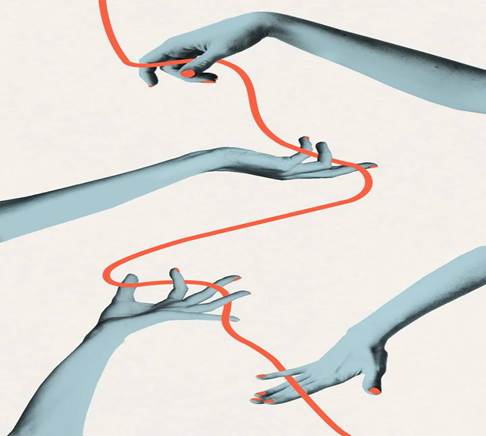
From a systems science perspective, who you are matters less than who you’re connected to. Imagine people as stars in a constellation: each star is unique, but it’s the connections between them that create the pattern. Researchers have found that this idea shows up across nature, from humans and ants to fruit flies and even cells in our bodies. Whether it’s a fly in a crowded bottle or a person surrounded by family and friends, strong social connections seem to send a universal “stay alive” signal. When those connections are weakened or lost, the risk of death increases, much like a cell that dies[literally]; deprivation of these signals leads to apoptosis or ‘cell suicide ’, leading to physiological breakdown.
In this view, the real story isn’t about an individual’s personality, intelligence, or biology; it’s about the invisible web of relationships that keeps living systems resilient. The human brain perceives social ties as a survival necessity. When individuals lack social contact, the brain triggers inflammatory cascades and physically alters neural processing, viewing the isolation as a threat.
The Farr-Bertillon effect suggests that married people, on average, have lower death rates and tend to live longer than unmarried, divorced, or widowed people.[2] Although the original observations did not account for the economic and social realities of single women—then or now—the overall pattern has persisted across populations.
If individuality were truly our natural default, why would something as deeply social as marriage leave such a measurable fingerprint on our lifespan?
Marriage can contribute to longevity predictors like strong social connections, financial stability, good sleep, and a sense of purpose. On the other hand, long-term singlehood in young adulthood is associated with declining life satisfaction and higher depression as individuals age.
So, the point is: we are social animals. Every living thing depends on each other to make it another day. In this sophisticated ecosystem, we abide by the rule of the sum. Aka the collective interest. If we ever decide that we have to stray away from it, we have to do it with caution, I believe. Even in the apocalypse, those who cooperate often have better odds of survival.
Individuality flourishes in the sweet comfort of a broad, uncensoring community; when basic needs [food, safety, belonging] are met by a stable community, we gain the freedom to explore who we are. As Abraham Maslow proposed, self-actualization sits at the very top of the pyramid.
Joining local groups like ekub, edir, or participating in neighborhood and workplace communities such as AWiB, book clubs, and workshops helps build bonds that restore a sense of well-being, as engagements like these provide the social infrastructure needed to combat the feeling of being trapped by modern isolation and maintain mental health.
The greatest misconception of modern individualism is believing that independence means the absence of dependence. In reality, human independence is built on invisible systems of dependence—families, communities, cultures, and relationships—that allow us the freedom to become individuals.
By Ruth Mekasha
Share with your Circle!
Ruthie indeed an even deeper insight.
If you want to go fast, go alone.
But
If you want to go further
Go together.