

Creative Minds:
Art for Social Change Recap
September has traditionally been a month dedicated to art at AWiB: a time to explore the ways creativity can challenge perspectives, amplify voices, inspire action, and create new possibilities. After a short August break, AWiBers and guests gathered on September 3 for an energizing evening of connection, creativity, and conversation at AWiB Connects @ the Hilton.
This September, AWiB opened the month with “Creative Minds: Art for Social Change,” a conversation exploring how art and creativity can drive societal change, create agency, and serve as powerful tools and mediums for expression, transformation, and collective action.
Following the networking session, Tsion Gebremedhen, AWiB’s 2026 President, welcomed the audience back to AWiB Connects and reflected on AWiB’s longstanding commitment to creating spaces where relevant conversations meet practical experience. She highlighted how AWiB Connects @ the Hilton has become a cornerstone of Addis Ababa’s professional community, bringing women and men together for meaningful dialogue, expanded networks, and the exchange of diverse perspectives.
In keeping with AWiB’s tradition of spotlighting members’ businesses and initiatives, Tsion invited members to briefly introduce and showcase their work. Asefach H/Selassie presented her books, while Sr. Asayech represented Tikuret Lesetoch ena Lehitsanat Mahiber.
Tsion invited attendees to visit the AWiB website and subscribe to The AWiB Effect, before unveiling the Fund for AWiB (FFA) initiative, a 1,500 Birr raffle ticket offering prizes collectively valued at approximately 207,000 Birr.
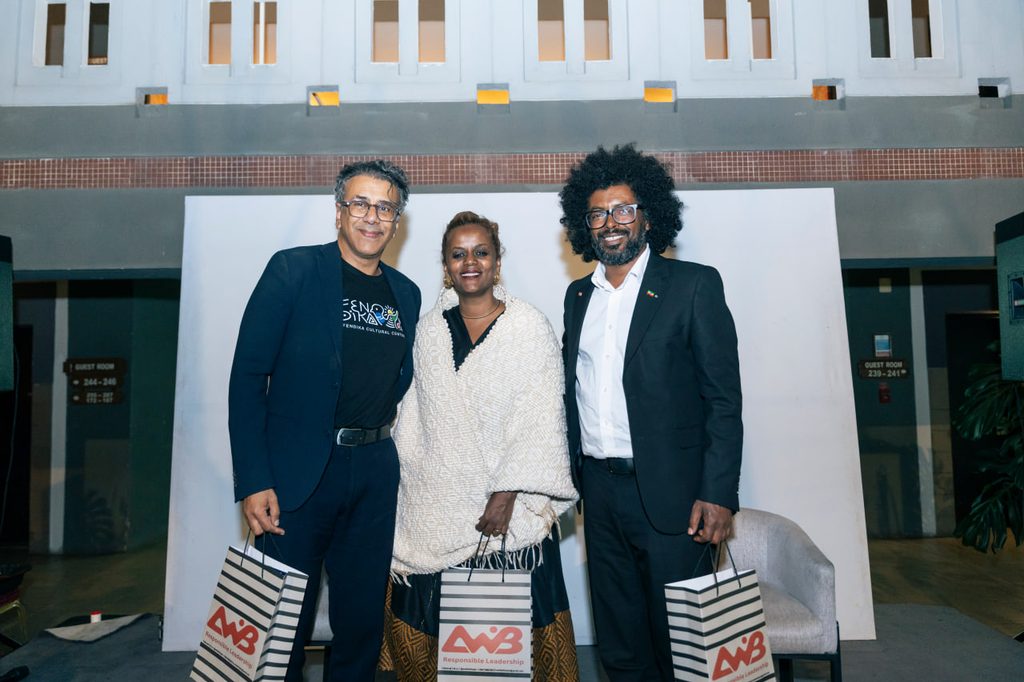
Tsion then introduced the evening’s moderator, Hiwot Emishaw, author and communications specialist. Hiwot took the stage and introduced the two panelists: Yasser Bagresh, Managing Director of Cactus Communications, and Melaku Belay, Founding Director of Fendika Cultural Center.
Melaku began by expressing his gratitude to AWiB for creating spaces where people can come together, exchange ideas, and have conversations that matter. He spoke candidly about the struggles faced by dancers and other creatives, particularly the unfair judgments surrounding artistic professions and the tendency to view creatives as something less than professionals.
For Melaku, changing that perception became personal. After years of dancing and experiencing the challenges faced by artists firsthand, he began thinking about how he could create a different ecosystem for dancers and traditional performers. He saved money, worked toward creating a sustainable space, and eventually took over the management of Fendika Azmari Bet in 2008. One of his early changes was significant: rather than having Azmari musicians and dancers rely solely on tips, he began paying them regular salaries. And that vision grew.
Fendika developed partnerships that created wider platforms for Azmaris and indigenous artists, while Melaku also worked to strengthen the professional infrastructure around Ethiopian dance and music. Then came COVID-19.
Like creatives around the world, Fendika faced an unprecedented crisis. The center was closed for seven months, while performances, touring, and the income that sustained artists disappeared. That same year, Fendika received another significant boost when it was named a 2020 Prince Claus Laureate, recognizing its impact as a catalyst for cultural expression in Ethiopia.
But the challenges did not end there. For years, Fendika faced pressure from rapid urban development in Kazanchis. In October 2024, the Fendika compound was ultimately demolished as part of the redevelopment of the area. Today, Melaku and the Fendika community are working toward rebuilding the institution, with plans for a 10-story cultural center that would house performance spaces, rehearsal studios, a recording studio, an art gallery, a library, meeting spaces, and artist residences.
Yasser Bagresh approached the conversation from another angle. He began by pointing to what he was wearing: a Fendika T-shirt: a small but delightful tribute to Melaku and his contribution to Ethiopian arts.
Yasser himself came to Ethiopia with a background in performance and dance. After spending 27 years in the United States, he returned to Ethiopia full of excitement and quickly discovered something that would shape the direction of his work: Ethiopia’s rich culture.
But there was a gap in the contemporary arts ecosystem. He created What’s Out, initially a tiny two-page publication designed to promote arts and culture. But he soon encountered a problem: there simply weren’t enough events to fill the publication.That realization changed the question. Instead of simply documenting what was happening, they needed to create the story.
Yasser spoke about his belief that arts and culture give a city its soul. His ambition became to bring more life into Addis Ababa by creating spaces, events, and experiences around art and culture. There was the Big Art Sale, the Bag Show, which helped raise funds for Our Father’s Kitchen, lectures, workshops, events, and Culture Talks. The events grew. They attracted the elite, expatriates, and the upper class. But Yasser realized something was missing.
“Don’t the masses deserve art and culture?”
That question led to a new approach. They launched Pasta Festa, celebrating one of Ethiopia’s ‘national’ food, followed by Coffee Fest. These events revealed something important: the appetite for arts and culture was not limited to a particular class or community. The masses were hungry for it too.
And a movement began. People came together. Companies joined. Institutions became involved. Communities participated. What started as individual events grew into a wider cultural movement in Addis Ababa.
Yasser reflected on the decades of learning that eventually led to the creation of Culture Club, a platform bringing different cultural initiatives and forms of art under one umbrella. Today, Culture Club hosts more than 60 events annually, reaching across different forms and mediums of the arts.
The audience was then invited to join the conversation, and the questions reflected both curiosity and genuine concern. Some participants asked how art can contribute to psychological healing and mental well-being, while others wondered how traditional art forms can evolve while still preserving their roots. There were also questions about how artists can remain authentic and meaningful in a world increasingly shaped by social media, distraction, and competition. One participant asked how adults who were once naturally creative as children could reconnect with that part of themselves.
The conversation also touched on the growing influence of AI in creative work and the importance of succession, how creative work and cultural knowledge can continue to live on beyond the individual who started it.
In response, Melaku spoke about dance as a powerful form of healing and connection, one that can bring people together regardless of language or background. He described Fendika as a space where people can express themselves, find release, and feel a sense of belonging. He also encouraged the audience to learn from traditional knowledge while not being afraid to reinterpret it and create something new from it.
Yasser, meanwhile, encouraged participants to think beyond popularity and focus instead on serving their communities and telling their own stories. He emphasized that finding one’s creative voice comes first, followed by the willingness to make the sacrifices needed to pursue it. Speaking about AI, he encouraged people not to fear the technology but to see it as a tool while remembering that it cannot replace the human experience, emotion, and soul behind creative work.
Both panelists ultimately returned to a similar message, creative work becomes meaningful and lasting when it is rooted in authenticity, purpose, and community.
As the session drew to a close, Hiwot brought the conversation back to something personal. Creativity, she reminded the audience, is not only about producing art, it can also be a way of finding our voice, connecting with others, healing, and creating change. When approached with intention and openness, creativity can become a practical tool for agency and social transformation.
Dr. Bethlehem Birhanu, 2026 AWiB President-Elect, then returned to the stage to express her appreciation to the moderator, panelists, sponsor, and everyone who took part in the evening. Tokens of appreciation were presented to the contributors.
But the evening did not really end when the formal program ended. Guests stayed behind, talking, exchanging contacts, sharing resources, and discussing possible collaborations. In many ways, this was a reflection of the very message of the evening, the impact of art and creativity is not limited to what happens on a stage or inside a gallery. It continues through the relationships we build, the ideas we exchange, and the collaborations that grow from bringing creative people together.
It was a fitting way to close a September evening that reminded everyone in the room that creativity is more than self-expression. It can be a source of healing, a means of finding one’s voice, a way to influence others, and, ultimately, a powerful tool for lasting transformation.
That is the possibility AWiB’s September theme set out to explore: what happens when creative minds are given the space, platforms, and partnerships to turn their ideas into action?
Share with your Circle!