

The Startup Fever and Its Outcomes Recap
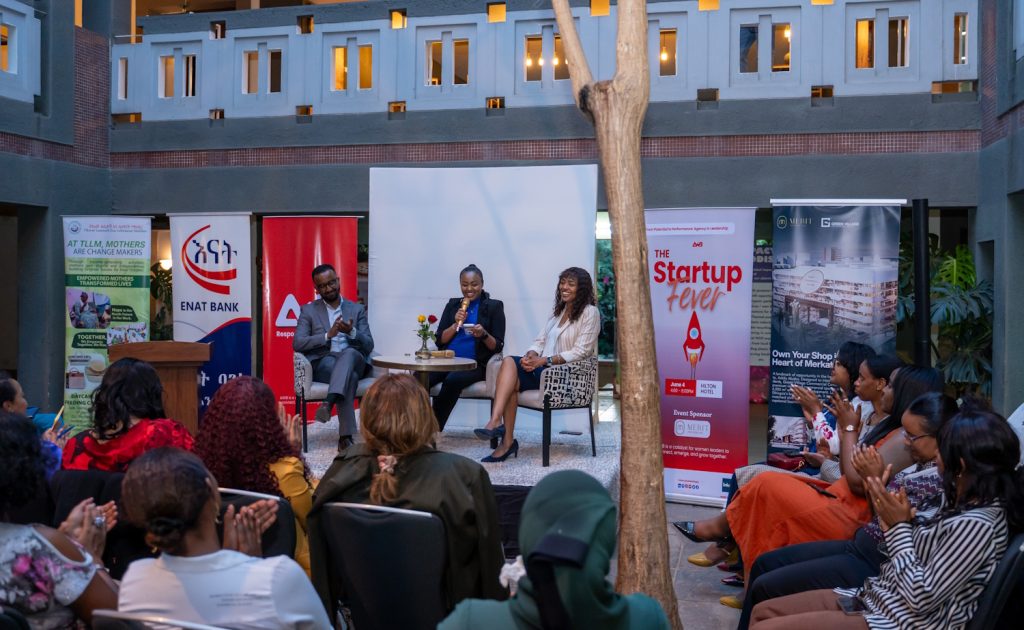
June’s AWiB Connects @ the Hilton brought together a dynamic and engaged community, filling the room with entrepreneurs, professionals, aspiring founders, and curious minds eager to explore a topic that has increasingly shaped conversations across Ethiopia’s business landscape. The Hilton atrium set a beautiful tone for the evening, with its warm ambiance inviting guests to settle in naturally as conversations sparked across tables and connections formed effortlessly throughout the room.
Tsion Gebremedhen, 2026 AWiB President, welcomed participants and reflected on AWiB’s longstanding commitment to creating spaces where relevant conversations meet practical experience. She highlighted how AWiB Connects @ the Hilton has become a cornerstone of Addis Ababa’s professional community, bringing together women and men for meaningful dialogue, expanded networks, and diverse perspectives. She encouraged non-members to explore AWiB’s networking platforms and Lighthouse Sessions, and noted that membership includes discounts from various organizations.
The evening’s sponsor, Merit Properties, represented by Kirubel Sisay, Sales Supervisor, was then invited to share insights about the company and its offerings. As part of AWiB’s membership perks, long-term members were also given the floor to introduce their services and products. Sister Asayech from Tikuret Association shared their current campaign to sponsor a child, and Seble Mekonnen introduced her brand, LAL Honey, before the program transitioned to the main discussion of the evening.
Tsion introduced the theme of the evening, “The Start-up Fever and Its Outcomes,” designed to examine both the excitement surrounding entrepreneurship and the realities that often remain hidden behind success stories. She handed the stage to moderator Samhal Guesh, Founder and CEO of Kabana Design and an entrepreneur known for her work in empowering women through enterprise development.
Samhal opened by reflecting on the rise of startup culture in Ethiopia over the past decade. While startups have introduced fresh energy, innovation, and employment opportunities, she challenged the audience to look beyond the excitement of launching a business and ask a more important question: are we building ventures designed for long-term impact and sustainability?
Samhal introduced two speakers for the evening. Seble Mekonnen, Founder of LAL Honey, returned to Ethiopia after more than fifteen years in the pharmaceutical industry in the United States to build a business celebrating Ethiopia’s rich honey heritage. Anteneh Tesfaye, Founder and CEO of Sheger Media and Technology, works at the intersection of research, data, and innovation, helping build knowledge infrastructure for Ethiopia’s growing entrepreneurial ecosystem.
Seble shared that she never initially considered herself a business woman. Her path into entrepreneurship emerged through exposure to agricultural development and Ethiopia’s vast honey industry. What began as curiosity evolved into a mission when she discovered a striking gap: Ethiopia is the largest producer of honey in Africa and among the top globally, yet contributes only a fraction of its potential to international markets. Structural challenges throughout the value chain, limited access to international standards, processing infrastructure, and market systems, continue to constrain growth. In response, LAL deliberately avoids exporting bulk honey, choosing instead to preserve the identity and story behind Ethiopia’s distinct honey varieties. For Seble, entrepreneurship is about ensuring that local communities, indigenous knowledge, and generations of beekeeping traditions receive the recognition and economic value they deserve. She was equally candid about the hardships: building a business is filled with setbacks and continuous learning, and sustaining one demands patience, resilience, and a willingness to understand every layer of the sector.
Anteneh shifted the conversation to the broader startup ecosystem, beginning by challenging a common assumption. While “startup” is often associated with technology and Silicon Valley, he defined it more broadly as any business searching for a sustainable and scalable model. Many startups fail, he argued, not because founders lack passion but because they lack clarity, a deep understanding of the problem they are solving, the customers they serve, and the business model that will allow them to survive and grow. He stressed that entrepreneurship is deeply personal, demanding self-awareness, discipline, and continuous self-examination. He also highlighted the importance of truth-seeking: businesses fail when founders ignore reality or build cultures where challenges are hidden. Sustainable growth requires confronting facts honestly and making difficult decisions grounded in what is actually happening. He further noted that quality alone is rarely enough; entrepreneurs must learn to communicate their value, build trust, and tell a compelling story, because in many cases the narrative around a product can be just as powerful as the product itself.
Then Samhal opened the floor for questions, inviting the audience to bring their real experiences and pressing concerns to the panelists.
The first question came from an entrepreneur manufacturing pasta, macaroni, and crisps from legumes, who was unsure whether to focus on exporting, scaling production, or securing funding. Both panelists encouraged her to first gain clarity on her business model and target market before deciding on direction, noting that trying to do everything at once is one of the most common ways founders lose momentum.
The second question raised the challenge of financial management and regulatory navigation in the Ethiopian context. Anteneh responded candidly, sharing that the regulatory environment is not designed to make business easy, having himself been audited three times. He advised founders to take personal ownership of understanding regulations from the start and to consider hiring even a part-time accountant or advisor early on.
The third question asked how entrepreneurs can balance business with a sense of purpose. Seble encouraged founders to identify the specific problem they are solving and the community they are serving, noting that purpose often reveals itself through those questions. Anteneh offered a contrasting view, arguing that in a market like Ethiopia, building a profitable business that creates jobs and delivers value is already a purpose in itself.
The final question, from Yodit Giday of Gidey Gebrhiwot Enterprise, asked what each panelist wished they had budgeted for at the start. Seble pointed to processing machinery and packaging, even recalling stopping sales for eight months because she refused to use substandard local packaging. Anteneh said he wished he had budgeted more time to speak with experienced entrepreneurs outside his business. Samhal closed with a lighthearted but sincere addition of her own: a budget for AWiB membership, crediting the network with connecting her to her accountant, lawyer, and earliest business advisors.
As the evening closed, both speakers reflected on lessons they wished they had known earlier, from budgeting for infrastructure to dedicating time to mentorship and learning from experienced entrepreneurs. Their reflections reinforced the evening’s strongest message: success is not about having all the answers at the start, but about continuously learning, adapting, and moving forward despite uncertainty. Finally, Samhal shared a reflection on the power of community, encouraging participants to invest not only in their businesses but in the relationships and spaces that sustain growth.
Dr Bethlehem Birhanu, 2026 AWiB President Elect, concluded by extending heartfelt gratitude to the moderator, panelists, sponsor, and participants, and the evening ended with gifts of appreciation for the speakers, leaving attendees with fresh perspectives and a deeper understanding that behind every startup story lies persistence, humility, and the courage to keep learning.
Share to your circles!