

The Grammar of Healing:
Art in Transitional Justice
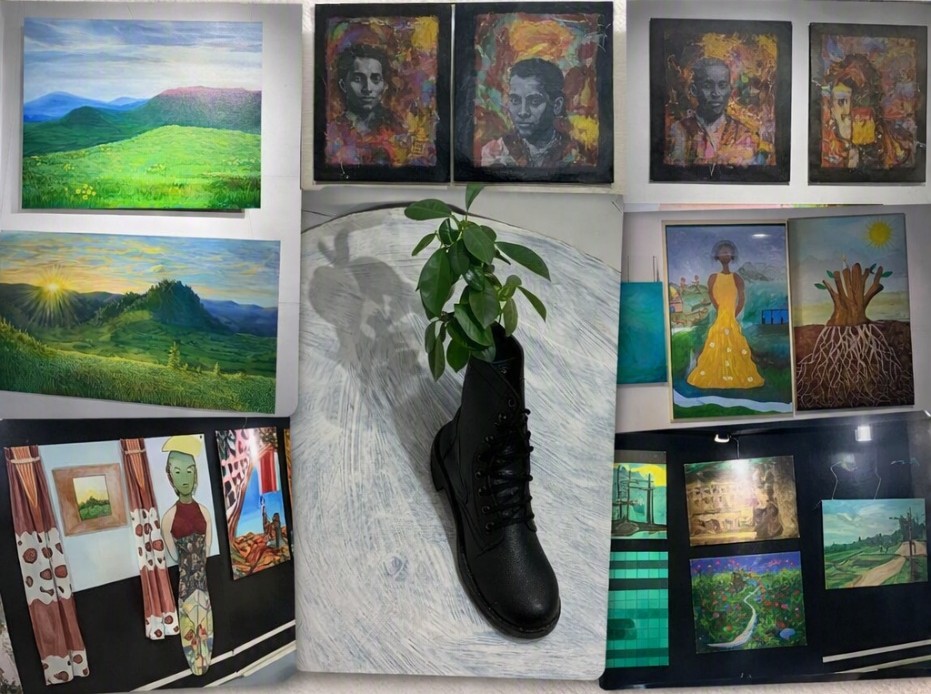
Last Month, Studio 11 Art Gallery hosted a profound conversation alongside the exhibition Grammar of Healing. Survivors of grave human rights violations entrusted their stories to artists, who translated them into paintings, sculptures, and drawings. The exhibition became an artistic showcase; a living archive of pain, resilience, and hope. Against this backdrop, the Association of Ethiopian Human Rights invited three panelists: a human rights expert, an art professor, and myself, a psychologist, to explore the role of art in transitional justice.
The human rights expert opened with a powerful reminder: transitional justice is not only about legal accountability but also about recognition and truth. Survivors often struggle to be heard in formal processes. Art, however, provides an alternative channel of testimony. A painting of a broken home, a sculpture of bound hands, or a drawing of a silenced face can communicate truths that words fail to capture.
In contexts where official narratives suppress or distort history, art becomes a counter‑narrative. It insists that memory be preserved, violations acknowledged, and survivors’ experiences validated. As the expert noted, art can function as evidence, not in a courtroom sense, but in the moral and social sense of bearing witness. It ensures that societies cannot easily forget.
The art professor emphasized the pedagogical dimension. Transitional justice is not only about addressing the past but also about shaping the future. Art educates communities by making abstract concepts tangible. A sculpture can embody the weight of oppression; a mural can depict the resilience of women rebuilding their lives; a performance can dramatize the tension between silence and speech.
Through exhibitions like Grammar of Healing, art creates collective memory. It invites audiences to engage emotionally, not just intellectually. This emotional engagement is crucial: reconciliation requires empathy, and empathy often arises when people feel rather than simply know. The professor argued that art makes memory accessible beyond academic texts or legal reports. It speaks directly to the public, across generations.
From my perspective as a psychologist, art’s greatest contribution lies in its therapeutic power. Trauma often resists verbalization; survivors may find words inadequate or overwhelming. Artistic expression offers a safe alternative. By externalizing pain through color, form, or rhythm, survivors can process their experiences without being retraumatized.
In my professional work, I have visited shelters where survivors of grave violations express their pain in group therapy. Storytelling circles have long provided spaces for displaced families to reclaim identity and dignity. Similarly, the works displayed in Grammar of Healing allowed survivors to transform silence into visibility. This act of creation is healing in itself: it restores agency, affirms resilience, and fosters connection.
Yet safeguards are essential. Art must be trauma‑informed. Without consent, confidentiality, and survivor agency, artistic projects risk exploitation or re-traumatization. Healing requires ethical practice, where survivors decide what is shared and how.
Together, the panelists highlighted how art bridges the personal and the political. Transitional justice often struggles to connect individual healing with collective reconciliation. Art provides that bridge. It complements psychosocial services by fostering dialogue, empathy, and recognition.
Memorials, murals, and exhibitions humanize statistics, reminding us that behind every number is a lived story. They create spaces where communities confront painful histories, not to dwell in despair but to move toward peace. In truth commissions and reconciliation processes, art can amplify survivor voices, ensuring that justice is not only legal but also emotional and cultural.
Grammar of Healing exemplified these principles. Survivors’ interviews became the raw material for artistic creation. The resulting works were not mere representations; they embodied lived experience. Visitors did not simply view art; they encountered testimony.
As a former member of the Ethiopian Reconciliation Commission, I have observed how transitional justice is carried out in various countries. My hope is that one outcome of our national dialogue will be restorative justice that facilitates healing for individuals and communities alike through shared emotional engagement, collective memory, and public acknowledgment of violations, thereby restoring human dignity.
The exhibition demonstrated that transitional justice is not confined to courts or commissions. It can unfold in galleries, theaters, and community spaces, wherever survivors’ voices are honored.
Transitional justice is ultimately about restoring dignity and building peace. Legal mechanisms alone cannot achieve this; they must be complemented by cultural and psychological dimensions. Art, as we witnessed in Grammar of Healing, embodies these dimensions. It transforms pain into collective strength, silence into voice, and memory into dialogue.
As societies confront histories of violence, art reminds us that healing is not only about the past but also about the future. Reconciliation becomes possible when survivors’ experiences are honored, empathy is fostered, and spaces are created where justice is lived, not just declared. We also learn “Never to Repeat” human-made catastrophes.
Share with your Circle!