

FCBC: The Impact of Mentorship & Coaching Recap
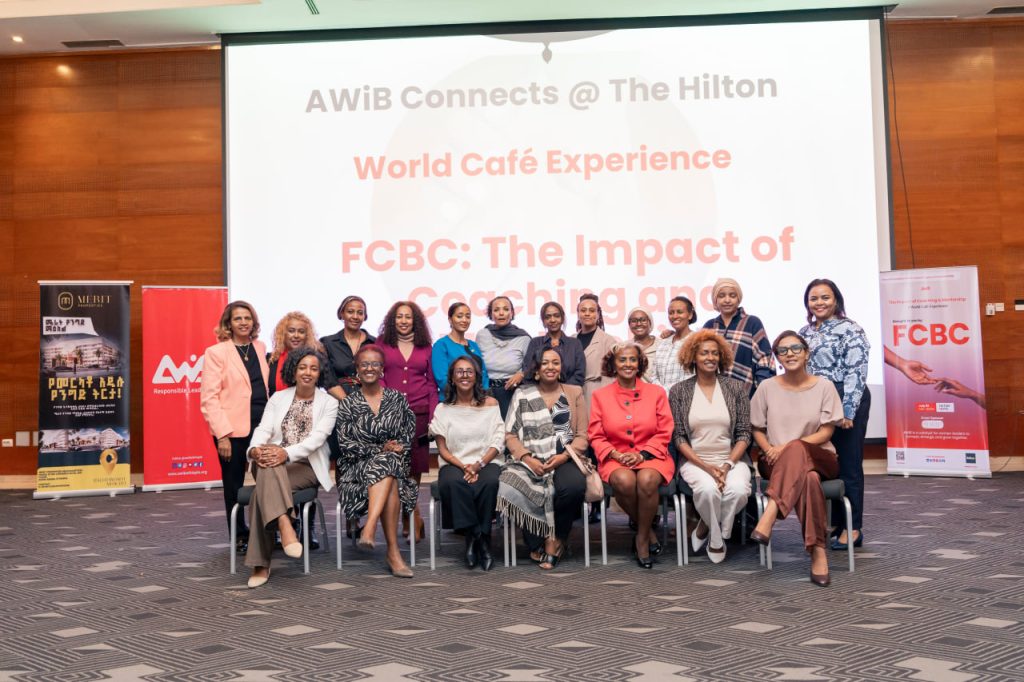
July is traditionally the month when AWiB presents HER Gems, and this year’s July AWiB Connects @ the Hilton gathered the well-known Female CEO Breakfast Club (FCBC), which is part of AWiB, around the theme: The Impact of Coaching and Mentorship.
On Thursday, July 2, beginning at 4 PM, members and guests gathered, eager to engage in meaningful conversations and network with Ethiopia’s leading women business owners, entrepreneurs, and executives. The evening began with a welcome from AWiB President-Elect, Dr. Bethlehem Birhanu, who reflected on AWiB’s commitment to creating spaces where practical experience meets purposeful dialogue. She also acknowledged the event sponsors, FCBC Members, and invited a representative from the other sponsor, Merit Properties, to share a bit about their offerings. AWiBers followed – Sister Asayech from Tikuret Association shared their current campaign to sponsor a child, and Samrawit Mulu introduced her brand, Glass Events and Advertising.
Dr. Bethlehem then warmly invited Samrawit Moges, CEO of Travel Ethiopia, to deliver the keynote address representing FCBC. With more than 25 years of experience in the tourism sector, Samrawit’s leadership journey reflects a commitment to creating opportunities for others beyond her own success. That made her message especially meaningful, as she is a living witness to the impacts of mentorship, collaboration, and community.
Samrawit opened her speech by emphasizing the extraordinary power of human connection. She reminded the audience that some of the most meaningful ideas, relationships, and business decisions do not always begin in formal boardrooms, but often through honest conversations shared among trusted friends.
She then reflected on the founding vision of FCBC, which began in 2017 as the fruition of Nahu S. Girma’s vision with a small group of women and has since grown into a vibrant community. Within the club, members share their failures and disappointments as openly as they celebrate their achievements to collectively learn lessons. She also shared how the club’s relationships extend beyond monthly breakfast meetings. Through celebrations, local outings, and memorable trips such as to Erta Ale and Zanzibar, FCBC members have strengthened the sense of sisterhood. She shared that being part of this club has been one of the most rewarding experiences of her life.
Samrawit’s words echoed throughout the room: “If you want to go fast, go alone; if you want to go far, go together.” This message beautifully summarized FCBC’s journey. She concluded with a call to all participants to continue dreaming boldly, leading with dignity, supporting one another wholeheartedly, and opening doors for the next generation of leaders.
Before the interactive session began, Samrawit reminded participants that the goal was not to find perfect answers, but to create meaningful conversations where every voice and every story could inspire someone else. She then introduced her fellow FCBC members, Yoadan Tilahun, Founder and CEO of Flawless Events, and Amakelech Lulu, CEO of Gishen Pharmacy, who facilitated the World Café Experience.
Yoadan and Amakelech soon took the stage, asked all the FCBC members to stand, and briefly introduced them.
After briefly introducing the topic of discussion and how the World Café works, Yoadan and Amakelech revealed the first question for the participants:
Who has most influenced your growth as a leader, and what made the greatest difference?
As facilitators collected reflections from participants, participants recognized that leadership is shaped by many people throughout different stages of life. Parents, grandparents, siblings, spouses, teachers, professors, supervisors, and friends were all identified as individuals who had left lasting impressions on their personal and professional growth.
Many participants spoke about the role of their parents in building confidence, resilience, and independence. Some shared that their fathers encouraged them to make their own decisions, while others credited their mothers with teaching them valuable life lessons, including challenging cultural expectations such as early marriage. Others reflected on how their supervisors, older siblings, and relatives helped them develop practical leadership skills, such as delegating responsibilities and leading by example.
In the workplace, participants emphasized the importance of supportive supervisors who trusted them with responsibilities, recognized their potential, hard work, and created opportunities for them to grow. Many also noted that they learned just as much from making mistakes and receiving constructive feedback.
Yoadan and Amakelech collected reflections and experiences from the different tables and summarized them with a great emphasis on how guidance is important for all of us at the different stages of our lives. It was then time for participants to disperse and form new groups at each table. This movement energized the experience, adding fun to the reflective discussions. The next question was then introduced.
Looking back on your leadership journey, when did you need a coach, and when did you need a mentor?
Many participants acknowledged that they had never clearly distinguished between coaching and mentoring before. Others shared personal experiences of receiving coaching during periods of identity crisis or career change, while some noted that mentorship from supervisors, life partners, or trusted individuals had helped guide important decisions.
Participants reflected on the many stages of life where coaching and mentorship could have made a meaningful difference. Common moments included starting a business, navigating career transitions, becoming a parent, developing leadership skills, improving communication and emotional intelligence, managing relationships, pursuing health goals, and finding a healthy work-life balance while avoiding burnout.
A few participants remarked that they had never been formally coached or mentored by a person, relying instead on AI and self-directed learning. Throughout the discussions, there was broad agreement that coaching and mentoring are valuable at every stage of life, particularly for young professionals, entrepreneurs, and individuals navigating significant personal or professional transitions.
In summary, the facilitators clarified the difference between coaching and mentoring. They described coaching as a professional relationship where the coach supports and guides the coachee on a specific skill, such as presentation skills, opening a business, creating a great team, and the like. Mentoring, on the other hand, is a deeply intimate relationship where the mentor guides the mentee in professional, personal, and deeply meaningful matters. It encompasses the whole 360-degree view of the mentee’s and the mentor’s lives. They stressed that the foundation for both relationships is trust.
After another round of reshuffling the circles, the third and final question followed.
As you continue to grow, what kind of support do you need now, and whose growth are you responsible for nurturing?
Participants expressed a strong desire for continued support in both their personal and professional development. Many identified coaching as their greatest need, particularly in areas such as prioritization, career development, financial literacy, entrepreneurship, leadership, change management, and navigating AI and emerging technologies. Others highlighted the need for financial support, information, and access to experienced mentors who could help them grow with greater confidence.
Participants also reflected on the responsibility they carry in supporting others. Many spoke about nurturing young girls, fresh graduates, children, nieces and nephews, and emerging entrepreneurs by sharing knowledge, skills, and opportunities. Others emphasized the importance of extending mentorship to boys as well, noting the need for stronger male role models within their communities.
Several women discussed balancing multiple responsibilities, including raising children while building businesses, volunteering, and supporting community development. Overall, the conversations reinforced a shared belief that growth is a continuous journey: one that is strengthened by guidance, meaningful relationships, and a commitment to helping others succeed alongside us.
Bringing the conversations together, the facilitators encouraged participants not to wait until they have everything figured out before seeking a coach or mentor. Guidance itself often creates the clarity needed to move forward.
As the evening drew to a close, Dr. Bethlehem Birhanu returned to the stage to thank and honor the FCBC members for facilitating the experience. Yet the conversations did not end there. Participants lingered long after the formal program, continuing discussions, exchanging contacts, and finding potential mentors, coaches, and collaborators. It was a fitting conclusion to an evening that demonstrated the true power of coaching and mentorship—not simply as professional tools, but as relationships that shape lives, strengthen communities, and empower women to grow together.
Share with your Circle!
Coaching sharpens a skill. Mentorship shapes a life.
FCBC and AWiB’s “Impact of Coaching and Mentorship” gathering reminded us of something worth sitting with: both are powerful, but they are not the same.
Coaching is performance and goal-oriented: structured questioning, accountability, action. It helps you unlock potential to hit a specific target: a pitch, a launch, a new skill.
Mentorship is slower and deeper. It’s a long-term relationship built on trust and shared experience, one that shapes not just what you can do, but who you become: your judgment, your values, your confidence, your sense of purpose. A coach helps you “do”. A mentor helps you “become”.
At Sankofa, we believe leadership isn’t measured only by what we achieve. It is measured by who we deliberately develop. Great leaders become mentors. Exceptional leaders build mentoring cultures, where wisdom moves across generations and every mentee is equipped to become tomorrow’s mentor.
One thing worth adding to the conversation: we need more male mentors stepping up too. Mentoring cultures can’t grow evenly if half the leadership pipeline is under-guided.
Thank you FCBC & AWiB for advancing this conversation. 🙌
Thank you for sharing the recap. It looks that it was a very interesting and rich discussion.