

Rigbe Gebrehawaria:
An Indomitable Spirit
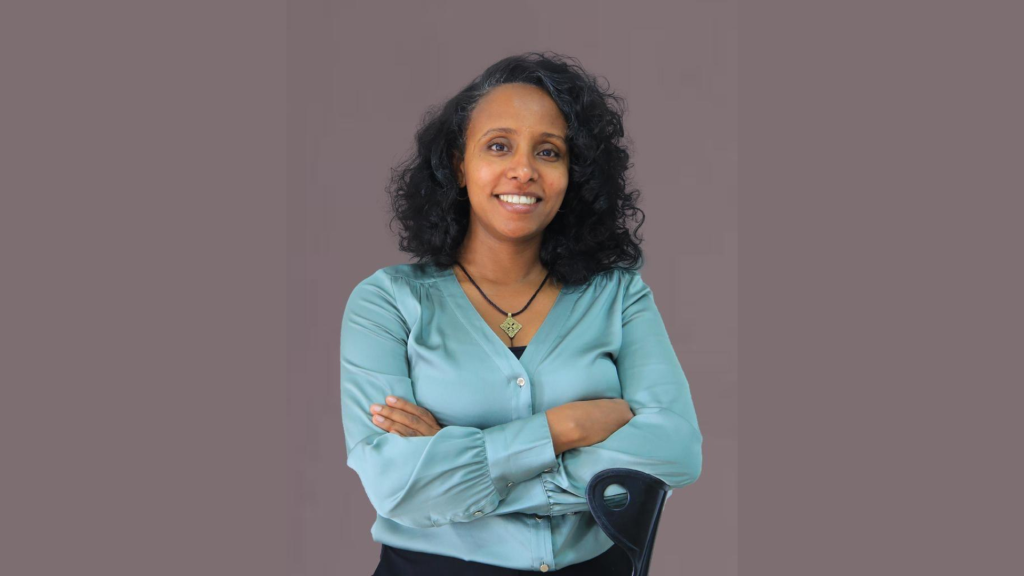
Born in the small northern Ethiopian town of Edaga Hamus, Rigbe Gebrehawaria entered the world as the third among seven children. To her parents, she was a long-awaited blessing, born after six years of prayers following her older brother’s birth. But at the age of two, life shifted unexpectedly when Rigbe contracted polio. By four, her parents had brought her to Addis Ababa in search of medical care, a temporary journey that soon became permanent as the entire family relocated to build a new life.
Rigbe grew up in a lively home that felt more like a community than a family unit, surrounded by relatives & friends. Raised by a warm and generous mother and a forward-thinking father with an unshakable belief in education, she was nurtured not with pity, but with possibilities. The Polio left impairments in Rigbe’s legs and she began to use assistive devices. Her father refused to let her condition define her future, he homeschooled her until second grade then tirelessly fought to enroll her at the Cathedral Nativity Girls School. She initially struggled to adapt to the new environment both academically and socially. But children, she says, taught her one of life’s greatest lessons about inclusion. They were curious, not judgmental. They asked questions freely, fascinated by things such as the fact that she could swim. School soon became the one place where she did not feel different. “For a long time,” she reflects, “I didn’t see what people saw in me.”
Adolescence introduced new realities to Rigbe. As her friends began exploring romantic relationships, Rigbe quietly wrestled with feelings of exclusion. For a long time, conversations about romantic relationships felt untouchable to her. Beyond her close circles, she noticed the sadness in people’s eyes when they looked at her. Slowly, she realized two painful truths: society viewed her as “different,” and disability was often framed through charity rather than dignity. “The physical barriers were manageable,” she says, “but the psychological pressure was far more difficult.”
Everything began to shift when Rigbe joined Addis Ababa University to study Law. She had chosen the field for its prestige and challenge, but once inside, she fell deeply in love with it. University became a place of liberation. She discovered confidence, joy, and freedom in herself. The attention she once interpreted as “Staring” slowly transformed into attention she could alchemize into something purposeful. Men began showing interest in her, and the femininity she had long buried re-emerged. For the first time, she allowed herself to imagine a future where she belonged fully, not partially.
After graduation, however, reality returned sharply. Finding work proved difficult. At first, Rigbe assumed unemployment was simply part of every graduate’s struggle, not yet connecting the barriers she faced to society’s perception of disability. She eventually joined the Ethiopian Women Lawyers Association, contributing through legal aid and research. She then went on to the Ethiopian Center for Disability and Development (ECDD), where she first worked on economic empowerment projects for people with disabilities. That role changed her life.
Until then, Rigbe had spent much of her life seeing herself simply as another person navigating the world. She had rarely interacted closely with other persons with disabilities and had never deeply reflected on what exclusion truly meant. At ECDD, surrounded by colleagues with disabilities and confronted daily by invisible systemic barriers, her perspective transformed. “I was made there,” she attests.
After several years at ECDD, marriage came then motherhood followed, briefly pulling her away from professional life. But when she attempted to return to the workforce, she faced the same barriers she had encountered as a young graduate. Rather than retreat, Rigbe took a bold step and launched her own consulting firm, Kenawi Consultancy, which is a Geez word for “Wisdom”. Though technically skilled, she admits she lacked the business mindset to sustain it long-term.
While faced with the challenge of running a business, an opportunity knocked her door, she was selected for the Mandela Washington Fellowship in the United States. She spent transformative weeks learning about leadership and advocacy in the US and at the graduation, Rigbe had the opportunity to meet the Former President Barack Obama. She returned home energized, convinced she could create lasting influence.
That belief gave birth to Ethiopia’s first inclusive fashion shows.
For Rigbe, the initiative was never about fashion alone. It was about dismantling society’s narrow definition of beauty. Kenawi Consultancy in collaboration with Ethiopian Fashion Designers Association and the U.S. Embassy, created a platform where models with and without disabilities walked together. All involved in the project received inclusion training, public auditions were held, and the confidence of those with disability who came for auditions visibly transformed before her eyes. By the second round of auditions, contestants who once hid their impairments arrived openly and proudly. The second year, Rigbe made the initiative a regional project involving participants from several East African Countries.
The impact rippled far beyond the runway. Young girls with disabilities watching from home could finally see themselves reflected in spaces they had once believed excluded them. Rigbe chose one of the very professions society least associated with disability and used it to challenge public consciousness. Soon, similar initiatives began emerging elsewhere, many inviting her to guide or inspire them.
Her next chapter took her to the U.S. Embassy Addis Ababa as a Senior HR Assistant and Disabilities Advisor, where she sharpened her expertise in leadership and people management. After serving the Embassy for four years, during Ethiopia’s reform period, she was nominated to join the Ethiopian Human Rights Commission (EHRC). She was then appointed Commissioner for Disability and Older Persons’ Rights by the parliament. She later became Commissioner for Women, Children, Older Persons, and Disability Rights, also leading the Women and Children’s Rights Department. The department itself did not exist before her arrival; Rigbe built it from the ground up, ensuring the rights of older persons and people with disabilities became a national agenda rather than an overlooked subsection.
Today, Rigbe continues to shape policy, advocate for inclusion across multiple platforms. She serves as a board member at the Strategic Initiative for Women in the Horn of Africa (SIHA) and co-founded the Ethiopian Lawyers with Disabilities Association (ELDA). Rigbe consistently advocated for a UN Convention on the Rights of Older Persons across international platforms which has the drafting now underway at the UN.
Despite the titles and achievements, Rigbe believes her deepest work is changing mindsets. She is an expert member of the working group on the rights of older persons and person with disabilities in Africa and serves as a Project Advisor at the GIZ AU Office. Rigbe is currently an AU endorsed Ethiopian Candidate to the UN Committee on the rights of persons with disability. She was also recognized as the Human Right Defender of the year in March 2026 by the EHRDC.
As a mother of two boys, and a leader many look up to Rigbe reflects that “Busyness is a mindset. For her, meaningful work does not drain life; it gives life meaning. Her strength comes from deep self-awareness, spirituality, and an uncompromising sense of presence. “I don’t wait for invitations,” she says confidently. “I claim my space.” She often entered rooms where she felt like an outsider determined not only to occupy space but to widen it for others behind her.
“Walk the talk,” she advises the younger generations “Your words matter, but becoming what you speak of is the real work.”
Rigbe’s life is a story of claiming space in a world that often hesitated to offer it.
AWiB thanks Rigbe for carving out time to share her story.
Share with your Circle!