Meseret Kassahun (Ph.D)
Turning Setbacks into Stepping Stones
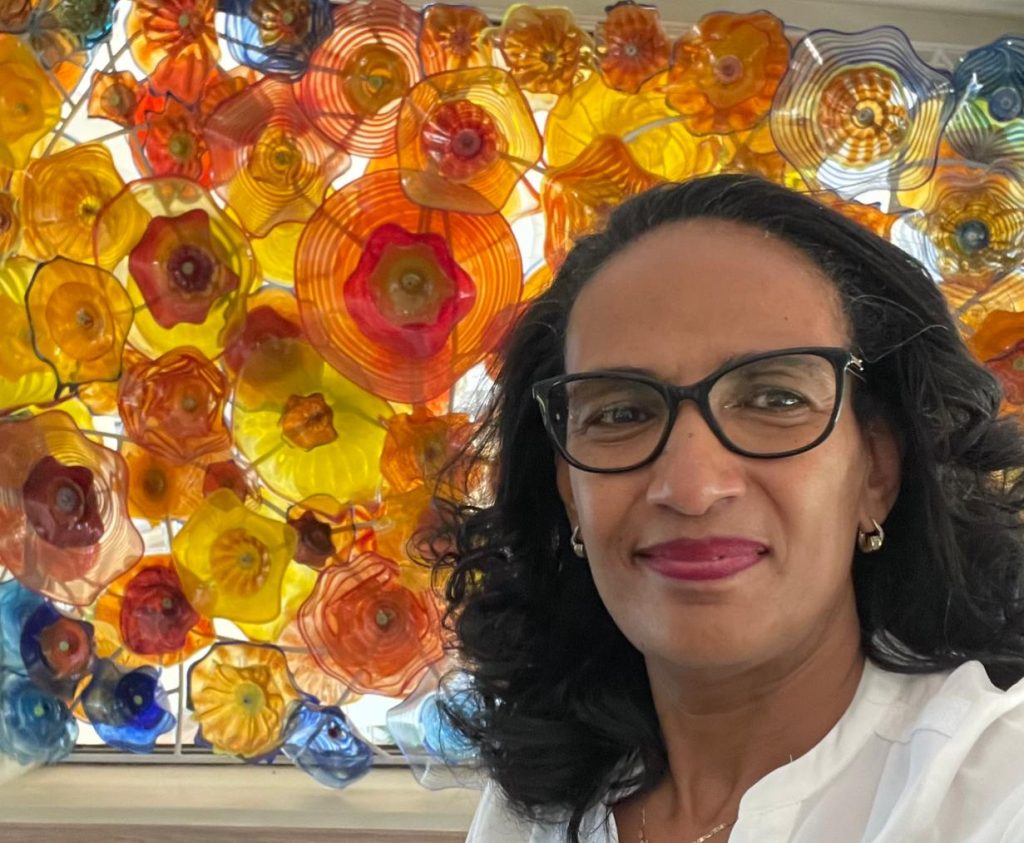
Dr. Meseret was born and raised in Butajira town, nestled in the former Gurage Zone, a small town where life moved at a quiet, measured pace. Her father was a civil servant and her mother a housewife. Out of three siblings, Meseret was the middle child.
Looking back, she describes her childhood as one marked by constraint, a reality shared by many Ethiopians especially those who grew up in rural areas. The opportunities her children enjoy today are worlds apart from her upbringing. Growing up in a town where resources were scarce and exposure limited, she often wonders where she might be if she’d had the same chances.
As a child, she loved writing and art, but like many dreams in Ethiopia, they weren’t nurtured. Still, she refused to accept limits quietly. In high school, she wrote poems, sent them to radio stations, and led the school’s mini-media department. A hunger for more kept pushing her. Another dream that was deferred was university education because she didn’t make the cut. Instead, she enrolled in Arba Minch Teachers Training Institute for a year. She became a primary school teacher at “Torra Elementary School”, remotely located.
But she wasn’t one to settle. Even while teaching, she sat for the Ethiopian School Leaving Certificate entrance exams as an individual candidate again and again, determined to improve her score. Still, her GPA stubbornly hovered at 3.4, just a little less of what she needed to qualify for university at the time. Leaving her job and moving to the city to attend university through extension classes felt out of reach, as she was the primary breadwinner.
She remained restless, unwilling to accept a life of limited prospects. Eventually, she secured a job with ActionAid Ethiopia, working on a rural development project in a neighboring Woreda, working closely with the farmer associations. As Meseret is a proponent of Girls’ education she used her position with ActionAid to mobilize communities to enroll children, especially girls, in non-formal basic education programs(grades 1-4). She walked long distances for it was the only mode of transportation. The Action Aid project also marked a turning point for Meseret. There was a resource center at her new workplace, and she spent countless hours reading and preparing for the university entrance exam.
On the way to the remote areas, there was a mountain called Kure Mountain in the Dalocha Woreda (now Silte Zone), and she often paused there, sitting to catch her breath, telling herself that this wasn’t the life she wanted. Something had to change.
Her dedication and hard work didn’t go unnoticed. After three years, the Country Director asked why she hadn’t applied for better positions. She replied that she had, but suspected ethnic bias shaped decisions. She seized the opportunity to request a transfer to Addis Ababa to study while working. Moved by her determination and diligence, the director facilitated her transfer within a week. She joined ProPride, a local civil society organization funded by ActionAid.
Without wasting time, Meseret enrolled in an extension program to earn her BA. She took four classes simultaneously, determined to finish quickly. It was a demanding time. She married, had two children, and balanced work, family, and relentless studies. But self-motivation and grit carried her through. She graduated with distinction, pursued a master’s degree, and again excelled—earning a perfect 4.0 GPA. She soon set her sights on a Ph.D. in the United States.
The Ph.D. journey was among her toughest. Leaving her two children and family in Ethiopia was emotionally draining. The stress led to illness, and she quit her program for a semester. Still, she returned and completed her doctorate in four and a half years.
Meseret returned to Ethiopia in 2011. Spent a year as a development consultant and took up a teaching position at Addis Ababa University’s School of Social Work at the request of her former BA thesis adviser. From 2012 until 2017, she served as an assistant professor, teaching, mentoring MA students, and coordinating graduate programs. However, by 2017, the political situation in Ethiopia had become tense and unstable. Known for her outspoken and critical voice, she faced increasing pressure. Eventually, she left for Nairobi, where she worked as an independent regional consultant.
Today, Meseret describes herself as a social scientist: a development specialist focusing on governance, gender, social and child protection. As part of her role, she has conducted national-level research and consulted across the Horn of Africa, working on women and peace agendas, and conflict analysis for IGAD and UNECA. She continues to work independently for UN agencies, mentoring youth and advocating for women’s empowerment, a cause deeply rooted in her personal experience.
She firmly believes the problem of gender inequality in Ethiopia remains unsolved. She’s critical of imported feminist theories that don’t fit the country’s cultural and social contexts, insisting that feminism is about gender justice and must be rooted in local realities. Foreign frameworks often fail because they overlook Ethiopia’s indigenous knowledge and traditions. Policy-making, she argues, suffers when social policies are simply copied and pasted from abroad.
Meseret asserts her greatest impact is not only in academic achievement, but in community service. At Addis Ababa University, she supported female students financially and volunteered in the child justice program under the Supreme Court. She also mediated family disputes always prioritizing the child’s best interest.
During the 5 years she worked at the university, she dedicated herself to community practice and conducted free training sessions prompted by the challenges she witnessed in the courts. Despite holding a Ph.D. and achieving financial stability, she feels her mission isn’t complete. Recalling why she came back to Ethiopia– to influence policy– the bigger lever for real change, she believes she can still do more. Her current ambition is working for the government by evaluating the gap and helping to create new policies.
She believes women leaders in the public sphere must diligently work to initiate new or alternative policy ideas instead of focusing only on implementing existing ones. Policies, she insists, can touch millions of lives and bring a transformative impact.
Her resilience, she says, is grounded in faith. The Bible has been her source of strength, teaching her values of hard work, humility, honesty, and discipline. She doesn’t procrastinate and manages stress through exercise and mindful living. She is always grateful for her supportive husband and her three children, whose love and encouragement keeps her driven.
Meseret doesn’t entertain limiting beliefs. Her faith assures her that no goal is unreachable. Even in hard times, she focuses on possibilities—praying and singing to uplift her spirit.
For her, leadership is not just about holding positions of power—it’s about inspiring and empowering others. She promotes engaging men in the conversation about gender equality because lasting change requires allies from both sides. Empowering, enabling, and creating support for everyone—without bias—is the only way forward, as one-sided efforts can deepen gender divides. In her free time, Dr. Meseret finds joy in exercise, gardening, and reading.
Having known AWiB for a long time, she encourages the association to expand its work into regional areas where support is needed most, suggesting broader outreach and mobilizing volunteers to maximize human resources for meaningful change.
AWiB deeply thanks Dr. Meseret for her time and wishes her continued impact and fulfillment on her journey.
Share to your circles!
impressed with her life and professional journey
She is a humble and dedicated academician while I Met her as MSW student at Addis Ababa University. What an inspiring story and great lesson for us. Thanks for sharing
She is a humble and dedicated academician when I Met her as MSW student at Addis Ababa University. What an inspiring story and great lesson for us. Thanks for sharing
Wow you are youth changemaker.I proud by your efforts.