Haset Summit Recap
Igniting Authentic Leaders, Cultivating Lasting Sisterhood
The Haset Summit which took place on June 26, 2025, at the Hilton Addis was a memorable and impactful day. It began with an outstanding pair of Haset graduates: Dr. Bethlehem Kifle Abegaz & Dr. Bethelhem Birhanu Geremew taking the stage as MCs and sharing a heartfelt reflection on their one-year journey within the Haset program.
They spoke of how Haset ignited their growth over the past year, shaping them into the authentic, inclusive, and impactful leaders they are today. They credited the program’s three core pillars for this transformation, offering them practical tools to navigate life with purpose. Through deep reflection, self-expression, and holistic wellness practices, their potential was awakened, and now they asserted that they lead with clarity and vision.
After a brief overview of the day’s program, the MCs introduced Saba G. Medhin, Executive Director of the Network of Ethiopian Women’s Associations (NEWA) and one of the exemplary women leaders in civil society.
Saba G. Medhin opened the event with a powerful message, celebrating the Haset Program’s role in empowering young women leaders in Ethiopia’s civil society sector. She highlighted the ongoing gender disparity in leadership, despite thousands of CSOs operating in the country, and emphasized the importance of nurturing female leadership to ensure sustainable change.
The Keynote address was delivered by Dr. Meseret Kassahun, a distinguished researcher and expert whose work has influenced and shaped the discourse of gender, social inclusion, and governance in our region. She led the groundbreaking national study on the barriers to women’s leadership in Ethiopia, which served as a foundation for the Haset Leadership Program.
The remarkable keynote was followed by a thirty-minute video that depicted the powerful journey of the participants within the one year that transformed them from the inside out, as they testify. From alleviating their self-doubt to challenging them into doing the tedious work of deep self-reflection, they presented their journey as a guiding light towards their best selves and the true leaders they are.
Following the video and a short coffee break was a panel discussion “Journey to Leadership” where all four speakers and the moderator were Haset graduates. The speakers were: Hawi Mekonnen – Team Leader, Family Assistance Program IOM, Samrawit Kasse – Agricultural mechanization Engineer, Ethiopian Agricultural Authority, Martha Assefa – RH/FP Project Coordinator & Gender Focal Person EPHA, and Mihret Nigussie – Program coordinator, Inclusion Africa. The panel was moderated by Betelhem Girma – Programme Officer, Irish Aid.
Bethelhem opened with a gentle but grounded question: “What made you say yes to Haset?”
Hawi, a working mother of two, didn’t hesitate. “Even with my packed work schedule and the responsibilities of raising two kids, I applied and completed the program,” she said with calmness in her voice. “Haset was the opportunity I had been waiting for. What made it truly transformative were the practical tools it provided. Not just theory, things I could apply right away.”
Turning to Samrawit, Bethelhem asked how the program met her where she was. Samrawit’s story unfolded with deep honesty. She had just come off a tough season – her first initiative hadn’t succeeded as she’d hoped, and doubt had begun to creep in. “I found Haset when I needed it most,” she shared. “I had always been a top student, especially in technical subjects, but soft skills? That was the gap Haset filled. It made me ask: Who am I? What makes me happy? And now, I approach my mission with the confidence and knowledge that I will succeed.”
When asked about what made Haset stand out, Martha “Though I attended many trainings before, this one was different. I didn’t miss a single session. The prominent women leaders who shared their stories with us each month weren’t just guest speakers; they were life changers.” What stuck with Martha the most, though, was how Haset encouraged self-reflection. From the deeply symbolic Tree of Life exercise to the wellness sessions, every part of the program was about going inward to lead outward. “We didn’t just learn, we shared our innermost thoughts and experiences. We became sisters.”
The panel turned introspective when Mihiret, a long-time leader, took the mic. She revealed how, after years of training others, she realized she hadn’t been investing in her own growth and development. “What caught my attention first was the name “Haset” – Joy. I love joy!” she said with a bold and beautiful smile on her face. “But what kept me was the method of delivery. In today’s world, content is everywhere. But how Haset delivers it… That’s where the transformation lies.” Through the program, she revisited her childhood experiences, explored her identity, and gained a deeper awareness of both her strengths and blind spots.
As the conversation evolved, Bethelhem posed a challenge: “How do you build collaborative, impactful teams?”
Mihiret, drawing from over five years of team leadership, responded confidently: “Knowledge is one thing. Putting it into practice is the real challenge.” She emphasized that Haset helped her strengthen her skills in giving feedback, which was once her shortcoming. She testifies that Haset helped her approach team-building as a strategic advantage, not just a necessity. “Clear goals, open communication, and clear division of tasks and responsibilities make teams impactful and efficient.”
Samrawit chimed in from her agricultural leadership perspective. “You can’t build shared goals without identifying the gaps first. That’s where it starts.” She spoke proudly of her work with women in agriculture, which comprises about sixty percent of the agricultural sector. Haset taught her to turn shared struggles into shared solutions.
Then Bethelhem asked, “How have you created meaningful change in your communities?”
Martha’s story drew quiet awe. Recalling a moment when hospital workers protested poor maternal healthcare, she recalled telling them: “While you’re outside protesting, mothers are inside suffering & dying.” She said that what Haset reinforced in her is a leadership that is vision-focused, relationship-based, and deeply human. “I lead not just with skills, but with example and purpose.”
As the panel concluded, reflections and questions flowed from the audience, many circling one key area: the program’s sustainability. In response, the graduates shared that they’ve already formed a Haset Alumni group and plan to keep the sisterhood alive. Their volunteer projects are also set to carry on beyond the program. While the second cohort is currently ongoing, funding for the third hasn’t been secured. This prompted the graduates to invite the audience and potential funders to be part of Haset’s future by opening doors to new funding opportunities.
The discussion wrapped up with laughter, applause, and lingering reflection. It was more than just a panel; it was a mosaic of lived experience, grit, and grace. Haset wasn’t a program these women joined; it became the mirror that helped them see and shape the leaders they are today. And as they stepped off the stage, they didn’t just leave with certificates. They carried sisterhood, clarity, and a commitment to lead with authenticity.
After lunch, graduates Semeret Demeke, Blen Admasu, Egziharya Meshesha, Misrak Admasu, and Ayenalem Gismie led a powerful dialogue on “The Impact of Future Women Leaders of Ethiopia.” Their conversation wove together personal stories, systemic critiques, and bold visions for the future.
Egziharya opened with a striking truth: “Being exceptional is actually the norm for a woman.” Yet systemic dual responsibilities, managing home and career, often limit women’s growth. She emphasized the need for mentorship and highlighted social media as a missed opportunity for connection and learning. Blen shared the emotional burden of leadership, describing how societal messages like “you’re not ready” create self-doubt. She called for a shift in how women leaders are perceived, not as emotional or unprepared, but as strong and evolving.
Semeret critiqued cultural norms that silence women: “When I had my first child, they told me to put down the laptop and pick up the diaper bag.” She called for visibility and voice for women, especially mothers, in both home and workplace. Misrak brought a policy lens, noting gaps in implementation despite progress. She emphasized the need to bridge the digital divide and strengthen community-level leadership.
Ayenalem offered a hopeful perspective, shaped by being raised by strong women. She stressed that resilience often grows from managing dual roles, and that beauty or intelligence alone does not ensure success. The group agreed: leadership requires balance, vulnerability, and collective effort, including the engagement of men. Haset gave them the tools to move from self-doubt to action. They urged for Haset’s expansion, long-term support, and mentorship beginning at school level.
They closed by celebrating the sisterhood built through Haset, declaring that true leadership means opening doors for others, and that, together, they can transform systems, not just individual lives.
The next program truly embodied the spirit of leadership in action, showcasing the graduates’ commitment to community impact through five inspiring volunteer projects. Helen Tilahun introduced a dynamic Women Empowerment Program, aimed at training 50 women in life skills, financial literacy, wellness, and legal rights, supported by mentorship and coaching. Destu Ahmed shared her team’s vision to empower the next generation of leaders through a Youth Mentorship Project, designed to guide high school students through personal and academic development by connecting them with dedicated mentors.
Melkam Amsalu and her team addressed one of the most fundamental needs: literacy. The Literacy Empowerment Program, which they already implemented in two public primary schools, benefited 120 students with support from 12 volunteers and over 350 donated books so far. Wosenyelesh Berhanu spotlighted the often-overlooked rights of children with terminal illnesses at TAPCCO. The project focused on fundraising, advocacy, and visibility for children with terminal illnesses, emphasizing the right to health and dignity.
Afomia Mamishet highlighted a thoughtful and innovative partnership with FENAID on a Project for Intellectual Disability, aimed at raising awareness, improving digital visibility, and supporting empowerment for children with intellectual disabilities.
The audience, inspired by the graduates’ leadership, was invited to a gallery walk during the coffee break, where they explored each project in depth and discovered ways to support or collaborate.
The afternoon continued with Dr. Sisay Sirgu, MD, MPH, Associate Professor, Provost, St. Paul’s Hospital MMC delivering a speech on The Importance of Male Partnerships. In his compelling address, Dr. Sisay made it clear that gender equity is not symbolic, it is transformational. Drawing on the example of St. Paul’s Hospital Millennium Medical College; where women lead in executive, academic, and operational roles, he demonstrated how intentional investment, institutional commitment, and male partnership can drive real change.
“Supporting women to rise into leadership is not a favor, it is their right,” he emphasized, urging male leaders to take bold, deliberate action. This includes sponsoring women, challenging bias, and reshaping systems to support work-life balance and equity. Citing global research, Dr. Sisay reminded the audience that “gender equity in leadership can save lives,” with evidence showing that patients treated by female surgeons have better outcomes.
He called on male leaders to stop waiting on the sidelines and instead step into allyship, stating: “Let us not wait to be invited. Let us not watch from the sidelines. Let us step up, speak up, and stand beside the women shaping our future.” His message was clear: empowering women is not just right, it is necessary for building stronger institutions, healthier systems, and a more just society.
The graduates then reached the most anticipated moment of the evening: the closing remarks delivered by Her Excellency, Ambassador Tadelech Hailemichael. Ambassador Tadelech spoke passionately about the critical need to build a nation led by women. She reflected on the difficult journeys women have faced both nationally and globally, highlighting the vital role of women’s leadership in building sustainable peace. She emphasized that women must be at the forefront of national policymaking, only then can gender equity laws be realized.
Ambassador Tadelech praised the Haset Women Leadership Program, commending its thoughtful research backed design and impeccable implementation. She expressed her honor in witnessing the graduation of such dynamic and promising young women, a moment that filled her with hope for the nation’s future.
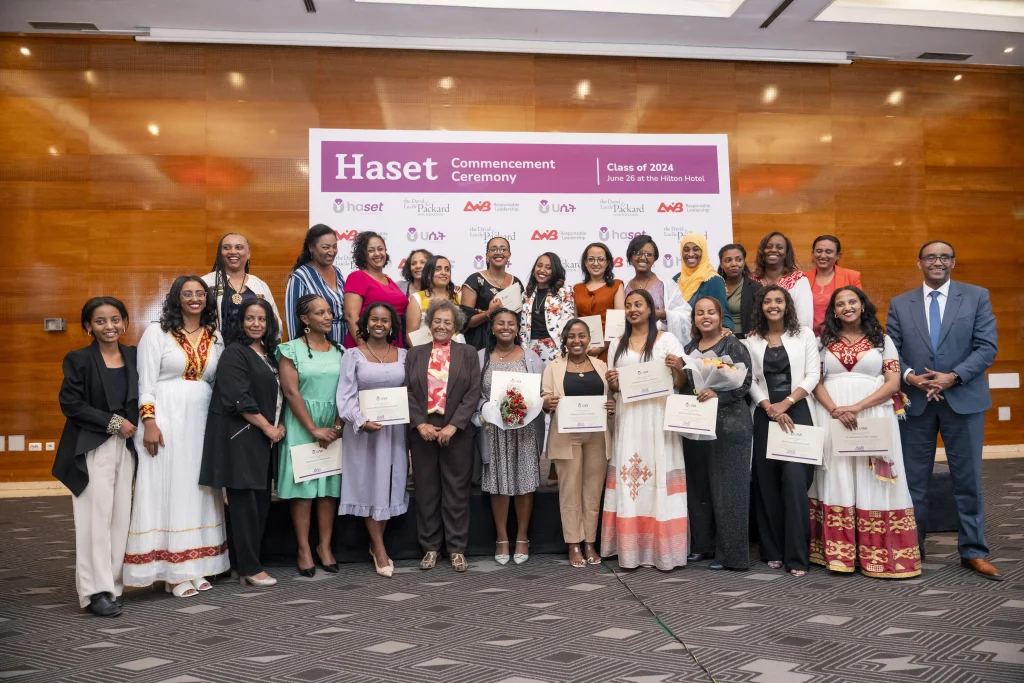
The Summit concluded with a heartfelt and unforgettable finale as Nahu Senay Girma, Founder and Director of AWiB, called the graduates to the stage. Ambassador Tadelech presented each graduate with their certificate, as their faces lit up with pride and the room echoed with cheers from family and friends.
The event closed with group photos, graduates and guests capturing the joy and significance of the day. It was a warm and fitting end to a powerful celebration marking the milestone achievement of the first cohort of the Haset Women Leadership Program.
Share to your circles!