From Chaos to Coherence:
Leadership that Listens Recap
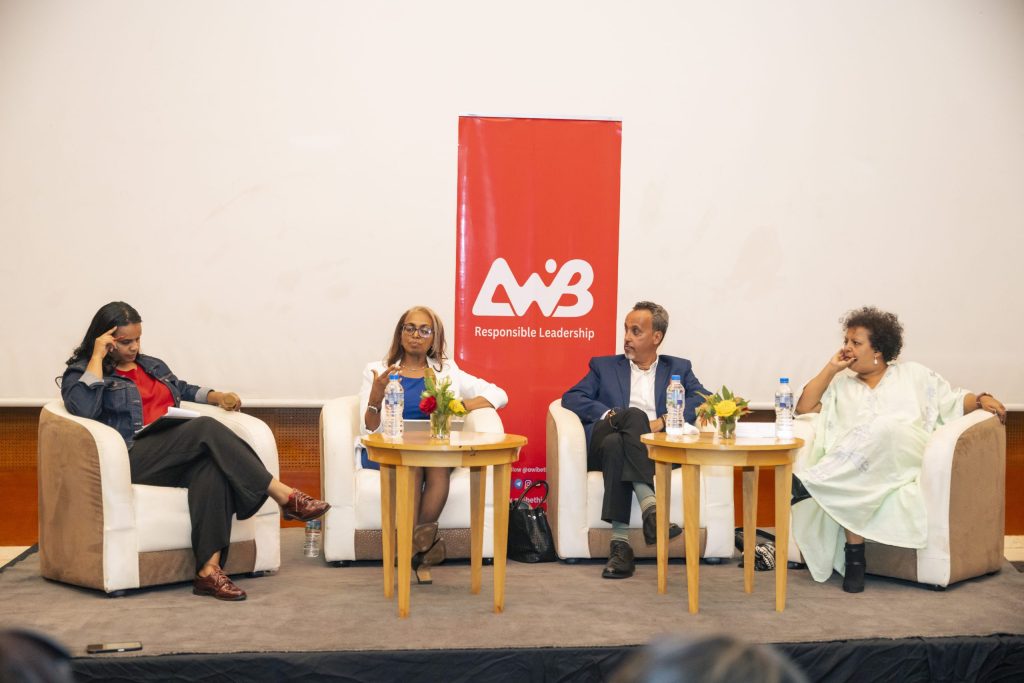
On the evening of October 9th, AWiB Connects @ the Hilton once again brought together members and guests for an evening of connection and conversation. The gathering offered a space to exchange ideas, reflect on shared experiences, and engage in purposeful dialogue. On each table, a thought-provoking networking question awaited: How do you navigate through emotionally charged conversations to stay present and truly listen to understand? The question set the tone for an evening that promised depth, honesty, and reflection.
As the evening unfolded, AWiB’s 2025 President, Jemila Hamid, took the stage and welcomed the guests. She reminded the audience that AWiB gatherings are more than discussions; they are spaces for reflection, inspiration, and renewal. As is customary at AWiB gatherings Jemila, she then invited members who were provided with tables to showcase products and services. A valued membership perk that highlights AWiB’s culture of collaboration and support. The members were Rihana Abdulkadir from an AI-powered real estate agent platform, Bezawit Admasu from Bezad Solutions, Yodit Gidey from GG Enterprise, Maria Mamo from Yaya Design, and Meskerem Kassahun from Ultra life.
In AWiB’s tradition of bringing current, relevant, and relatable topics to the table, this night was no different. The discussion promised depth and reflection, exploring how leadership that listens can transform chaos into coherence. Jemila then returned to the stage to introduce the moderator of the evening, Dalaya Ashenafi, Senior Researcher and Program Manager at Initiative Africa, who would guide the night’s conversation.
Dalaya began by inviting the audience to reflect. “Look around,” she said. “In our cities, in our social media feeds, even within ourselves, we see reflections of chaos. But what if leadership was not about speaking louder, but about listening deeper?” Her question lingered in the room as she introduced the evening’s speakers: Aster Birke Asfaw, Consultant, Trainer, and Facilitator; Professor Panagiotis (Panos) Hatziandreas, Co-founder and General Manager of Lebawi International Academy; and Rakeb Messele Aberra, Human Rights Lawyer and Advocate.
The conversation began with Aster Birke, who drew from decades of work in civil society and peacebuilding. With her calm authority, she reflected on the role of listening in leadership and in social cohesion. “In communication, hearing is natural,” she explained, “but listening requires intention.” Aster reminded the audience that Ethiopia, though rich in traditional wisdom, has drifted away from its culture of deep listening. Once a society guided by elders who listened with empathy and fairness, today’s discourse often prizes reaction over reflection.
She spoke candidly of a polarized environment where identity defines whose voice is valued. “We have become a society that filters meaning through bias,” she said. “Individualism is not celebrated; it is crushed.” The room grew quiet as Aster invited listeners to reclaim the balance between self and collective, to create safe spaces where people can express authentic views without fear.
Her reflections were both personal and historical. She reminded the audience of moments in Ethiopia’s past when leaders listened beyond their own egos to rally a nation around a shared purpose. “When leaders give space for feedback and self-awareness,” she said, “they move us from competition to collaboration, from control to coherence.” Her words called for a return to transformative leadership that begins with self-knowledge and grows through empathy.
Following Aster, Panos brought a contemplative and psychological perspective to the theme. His presentation, softly spoken yet profound, explored what he called “deep listening.” He began by referencing a passage from the event’s concept note: “Our country and inner world cry out not for more control, but for deeper listening. From chaos to coherence, the path forward begins in silence.”
Panos explained that active listening goes beyond words; it is about understanding emotions, presence, and intention. To illustrate, he shared a striking metaphor. “Imagine a bird building her nest,” he said. “On another branch sits another bird watching her. It is the same bird. One acts; the other observes.” The audience sat in stillness, reflecting on the image.
He continued, “In every moment, there is a part of us that acts and a part that observes. The key to deep listening is to stay connected with that observer as we engage. When we listen to ourselves, we learn to listen to others.” Through patience and presence, he explained, we can create space for genuine understanding. His words reminded everyone that leadership begins within, that calm awareness is not passivity but strength.
Closing the circle, Rakeb shifted the focus from the individual to the institutional and societal. Drawing on her experience in human rights, she examined how leadership that listens can transform organizations and communities. “Listening is not a soft skill,” she began. “It is the foundation of accountability.”
She recounted her time leading institutional reform in the Ethiopian Human Rights Commission, where her team transformed a fractured organization into one rooted in trust. “Our open-door policy was not symbolic,” she said. “It became a daily practice of hearing voices that were once silenced.” Through intentional listening, they built a culture of safety and transparency.
Rakeb spoke about the weight of silence in leadership, especially during times of conflict. “When leaders fail to listen, silence becomes complicity,” she said. “Listening recognizes suffering. It restores dignity.” She urged the audience to imagine a country where every leader listens with intent and where institutions embody empathy as much as enforcement. Her message was clear: authentic listening is not weakness but moral courage.
When the floor opened for questions, participants engaged with thoughtful inquiries. One participant asked how leaders can navigate fear and conflict, especially when some seem to benefit from chaos. Others raised questions on generational communication, the impact of social media, and setting boundaries in leadership.
Aster responded by reminding everyone that even in polarized environments, individuals hold power through choice and courage. She spoke of the “silent majority” that remains peaceful yet disengaged, urging people, especially women, to reclaim their voice. “If we wait until the problem reaches our doorstep,” she said, “we continue the same cycle. Be yourself, stand your ground, and set boundaries without apology.”
Panos emphasized that authentic leadership begins with self-awareness. “A leader who listens deeply creates safety,” he said. “Authenticity is not weakness; it builds trust.” He explained that a culture of listening takes time and consistency, not quick fixes.
Rakeb addressed the complexity of leading in institutions. She shared how not everyone in decision-making roles embodies leadership. “Some control, but they don’t communicate,” she said. “Leadership requires competence, compassion, and clarity.” On intergenerational gaps, Rakeb added with humor that young people’s realities differ from their parents. “It’s not their job to adjust, it’s ours,” she said, nothing that adapting to new forms of communication keeps leaders relevant.
As the evening drew to a close, moderator Dalaya reflected, “Tonight, I didn’t listen to summarize. I listened to understand.” Her words captured the essence of the evening.
AWiB’s October gathering concluded with gratitude and the presentation of tokens of appreciation to the speakers. In a world often filled with noise, the evening reminded everyone that coherence begins with the courage to listen deeply; to ourselves, to one another, and to the world we are shaping together.
Share to your circles!
Thanks sharing us the recap of October event I also agreed leaders responsibility of deep listening. Listening had a power to change communication gap. I would like to thank the speakers sharing us their rich. Experience on the topic