Planned Obsolescence and Its Psychological Dilemma
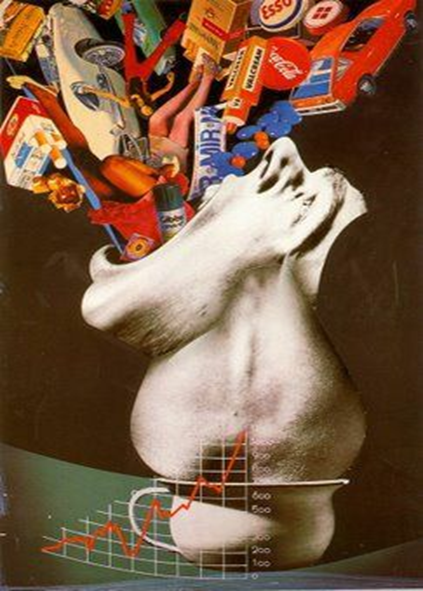
/Definition: Planned obsolescence is a policy of producing consumer goods that rapidly become obsolete and so require replacing, achieved by frequent changes in design, termination of the supply of spare parts, and the use of non-durable materials./
Most times, Modernity is defined by its break from the past. Modern life represents luxury and consumption like never before; not just of things, but of ways of living. We move forward relentlessly, rarely looking back. But it begs the question: was there no silver lining in simplicity, in some ways more than others?
“Working chiefly to consume, consuming to achieve status, accumulating things that have no meaning, wasting on a gigantic scale- these are the conditions in which we live. The result is a wasteland of junk and of human aspirations.” Joseph Wood Krutch
Krutch was not a socialist. Yet he urged a kind of personal renaissance where we derive connection to nature and to ourselves, in one’s relationship to one’s inner life. Instead of a loving and thinking individual, our sense of self now stems almost entirely from his socio- economic role.
Within this cycle of endless acquisition, our things inevitably wear out and demand replacement. But how quickly do those ‘things’ wear out?
Consider this: during world war 2, there were factories specifically made to produce war materials- ammunition, tanks, machinery. When the war ended, there were empty factories and manpower to utilize. Goods were manufactured in excess of people’s actual needs. A new problem arose: how to keep people buying. They had to think of a marketing strategy to make the people keep needing and wanting more. That’s when some evil genius[ a couple of them] started making products designed to fail, with cheaper internal components forcing people to replace what they already owned. Well, the disposable culture persisted.
Today, Durability has become suspicious; if something lasts too long, we stop trusting it. Not just products, but everything has become fleeting. An aesthetic that is replaced weekly, conversations aimless and obsolete. Aging, then, is treated as a flaw- objects, bodies, people; never to be the same again.
While chasing the new and shiny, we have lost the art of appreciation, whilst suckling endlessly at material appetite, hungry for things. A system that keeps us anxious in waiting, waiting for an upgrade. Our fashion taste succumbed to the next TikTok trend, the next iPhone update, or the endless churn of beauty standards in pursuit of novelty.
What society refuses to look at ceases to exist morally. Nowhere is this clearer than in how we treat aging women. This is not a critique of biological aging, but of cultural aging.
We are aware that legitimacy declines over time, but it has a disproportionate impact on women. As women gain power in public life, the pressure to remain young intensifies. It’s obvious, isn it? Our value is tied to our youth, sexual desirability, fertility, and beauty. Time itself becomes a ticking bomb. We are made to panic as we lose the traits that make us palatable- to men, to women, to society at large. For instance, some women avoid social events mainly because of domestic responsibilities, but also feel ashamed to join spaces where they do not ‘fit in,’ while older men navigate the same space freely. In this sense, we can be seen as a form of planned obsolescence, making this psychological warfare a man-made phenomenon.
A world where everything expires teaches us to move on quickly, but it also teaches us to hold less, care less, and stay unrooted. Things no longer carry stories; they carry timestamps. A society built on its own quicksand.
Breaking this cycle requires a conscious, counter-cultural act: choosing to value the durable, the repairable, the timeless, and the deep. It means rejecting the premise that “new” is inherently better. It’s a philosophy of care over consumption—for our objects, our attention, our relationships, and our being. It is, in theory, the antidote to the very wasteland Krutch warned us about, even if it is easier said than done.
Let’s humor eachother.
Written by Ruth Mekasha
Share with your circles!