11th AWiB Annual May Forum Recap
Education: The Great Equalizer or Divider
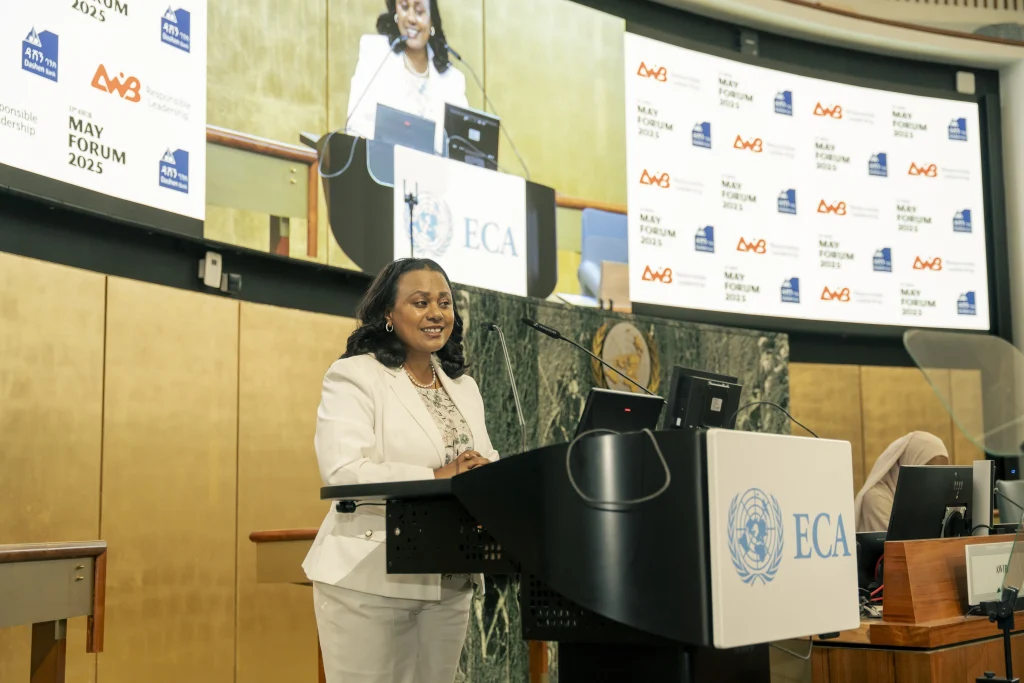
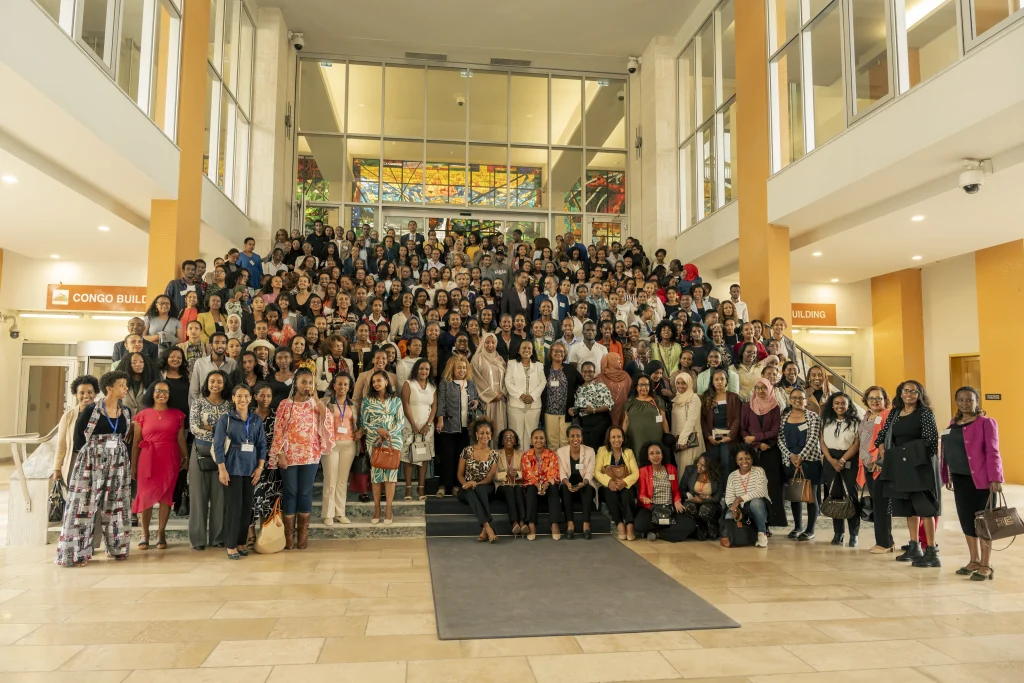
Early morning at Africa Hall, over 400 participants including eminent speakers, professionals from various sectors and sponsored university students. Women of diverse in age, background, and profession gathered, each carrying stories only they could tell. The air was thick with anticipation, not just for information, but for connection. AWiB is a sanctuary where women show up as they are, leaving judgment behind. Inside UNECA’s gates, strangers became sisters.
The day’s theme was vivid: a boy standing between two realities—a world of privilege and a classroom in disrepair. This wasn’t history; it was today. Education is urgent, fragile, and revolutionary.
AWiB’s 2025 President, Jemila Hamid, welcomed the crowd with pride and joy. A video showcased AWiB’s impact—a mirror to women’s growth when united. Here, women lift one another, learn, lead, and find their truest selves. AWiB teaches that women must first equip themselves before leading others. From villages to global platforms, the journey begins here.
Bold women face resistance, but AWiB stands strong, showing true confidence means lifting others even after being knocked down. AWiB is not just an organization—it’s a movement, a forge of ideas and cradle for dreams. Its legacy is bold, unshakable, and here to stay.
After Jemila offered a brief overview of the day’s topics, we had the honor of meeting our invaluable sponsors—the driving force behind making events like this possible. Our deepest gratitude goes to Dashen Bank, our sole sponsor for two consecutive years, whose unwavering support since 2013 has made these empowering days accessible to women across the nation.
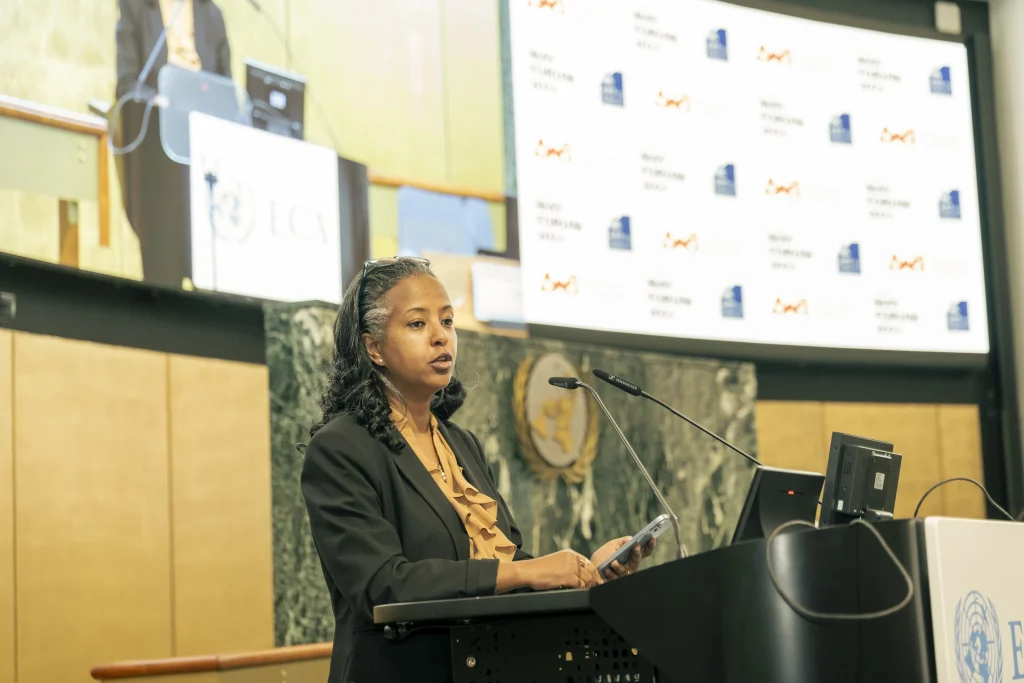
Hewate Kefelegn, Chief People Officer of Dashen Bank, spoke on their behalf with heartfelt conviction. She affirmed that the topic we gathered to discuss is timely and urgent. Recognizing the duality in education is the essential first step. Dashen Bank believes that education must be matched with intentional, bold action to create lasting change. She acknowledged AWiB’s crucial role as a platform for such transformative conversations, calling us torchbearers of this vital cause. Education, she said, does not simply change individuals—it reshapes communities.
Hewate also spoke of Dashen Bank’s CEO, Ato Asfaw Alewmu—a committed champion of women’s leadership whose dedication was made evident through her words. Ato Asfaw has consistently demonstrated his belief in the power of women, backing it with sustained action and measurable impact. His leadership reflects a vision that values equity, inclusion, and real transformation.
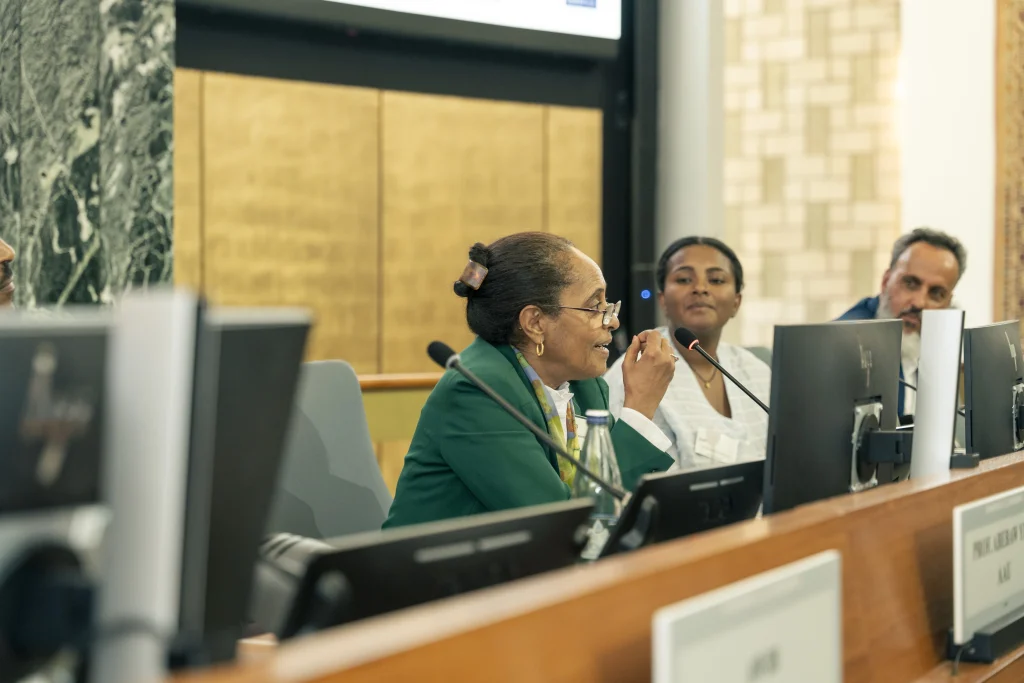
With heartfelt energy and reverence, Jemila returned to the stage to introduce a woman whose very name commands respect in education and leadership: Professor Hirut Woldemariam, Under-Secretary-General for REEF at OSC. From the lecture halls of Addis Ababa University to national policymaking, she has lived the promise of learning. Professor Hirut served as Ethiopia’s Minister of Culture and Tourism, Minister of Labor and Social Affairs, Minister of Science and Higher Education, and later as Minister and Social Sector Advisor to the Prime Minister.
With her presence embodying the spirit of learning, AWiBers sat eagerly as she took the podium. With a smile that caught the eye and wisdom written all over her, her paced speech held every listener captive.
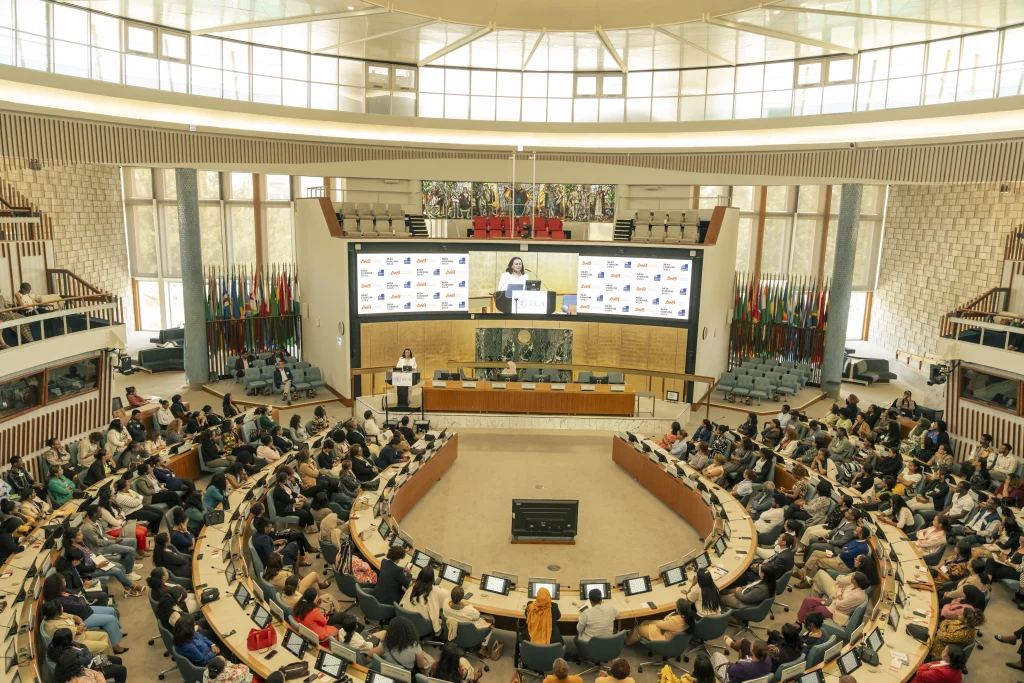
Keynote – Education: The Great Equalizer or Divider?
“A double-edged sword,” she called it. One edge cuts deep, leaving wounds of exclusion and inequality. The other sharpens, uplifts, and refines. One bleeds, the other blossoms.
Education elevates communities through innovation and strengthens economies. Individually, it starts from learning ABCs to career breakthroughs, leadership, and personal transformation.
But the same sword carves gaps. On the other edge, women are disadvantaged, denied education, suffering a drought not of water, but of opportunity. Stripped of knowledge by the communities that would have flourished from their brilliance, denied the very sword that breaks cycles of poverty. Denied the chance to read, grow, become financially independent, and rise as advocates for change that challenge traditional roles that silently drain society.
Education is the cornerstone of growth locally, nationally, and globally. It opens doors to leadership, entrepreneurship, politics—you name it. Nations investing in education have risen out of poverty and now enjoy the comfort of wisdom.
So, is education a divider? Her response was firm: Yes.
It divides when misused. When wielded by systems aiming to oppress. She reminded us of colonial education systems that elevated colonizers’ values while erasing indigenous wisdom.
Yes, it divides when access is denied. Over 32 million in our country remain out of reach. Gender disparity sharpens higher up the ladder. The gap widens; the bridge thins. Only 30% of university students are women, and fewer graduate.
Before a girl tastes education’s fruit, her parents marry her off. Before a woman fulfills her potential, she’s pushed out. In a system favoring men, women are invisible in leadership and decision-making.
Professor Hirut held up a mirror to our reality. The elephant in the room, the knock still unanswered. She spoke of schools with no qualified teachers, children walking miles to class, overcrowded rooms, one book shared by three students. We don’t compete on fair fields. Education quality varies sharply between urban and rural schools. Lack of digital literacy, electricity, equipment, and language inclusivity deepen ignorance. No, the tools are not distributed equally. In such times, education fails to equalize.
What is the way forward?
Let us maximize education itself—not just a privilege but a right and a tool for transformation. We must do more than enroll women—we must ensure they thrive and rise to shape the systems that excluded them. Unlock the potential in every girl and woman with the right tools. Beyond women, fight for equity for underserved communities—those left in opportunity’s shadows. We must act—governments, policymakers, private and civil society—collaboratively, intentionally, urgently. Listen to women. Center their voices to shape education’s future. Professor Hirut spoke with more depth and breadth than can be captured here, but her words stay in our hearts.
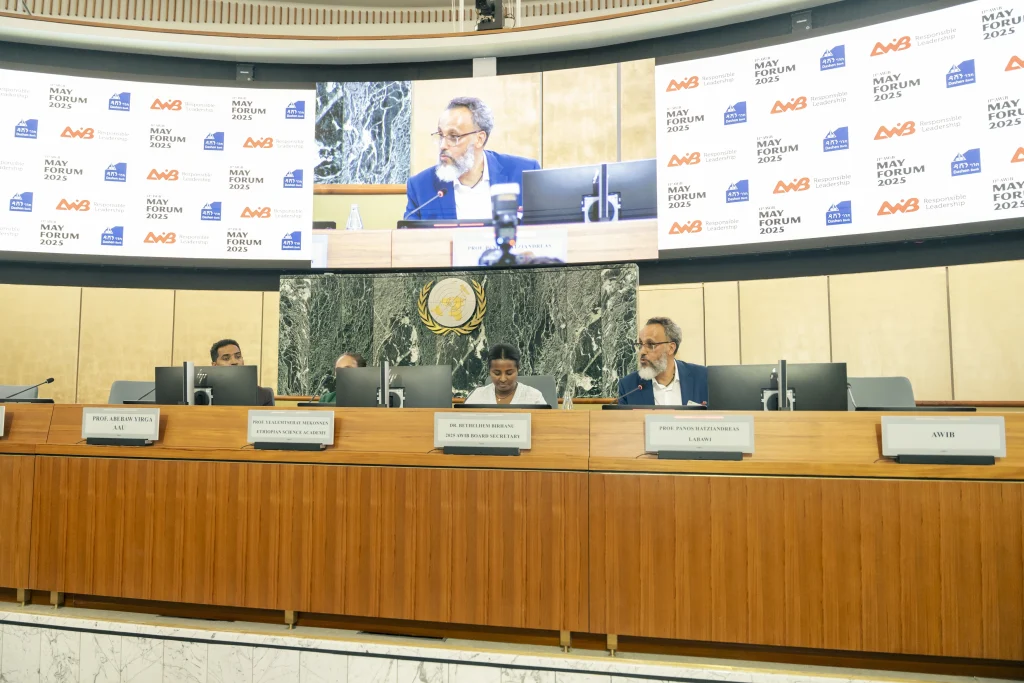
Dialogue – Running on Empty: Education and Ethiopia
After a vibrant morning of networking, participants gathered in the historic Africa Hall for the much-anticipated main dialogue, “Running on Empty: Education and Ethiopia.” The hall buzzed with anticipation as a diverse group of attendees explored the pressing challenges facing Ethiopia’s education sector.
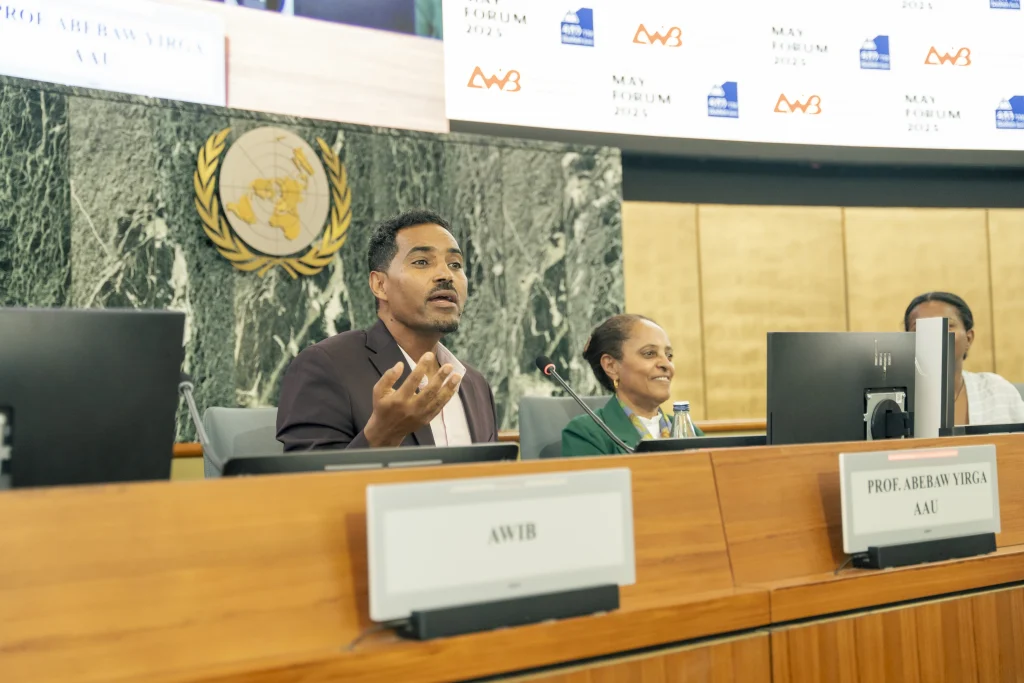
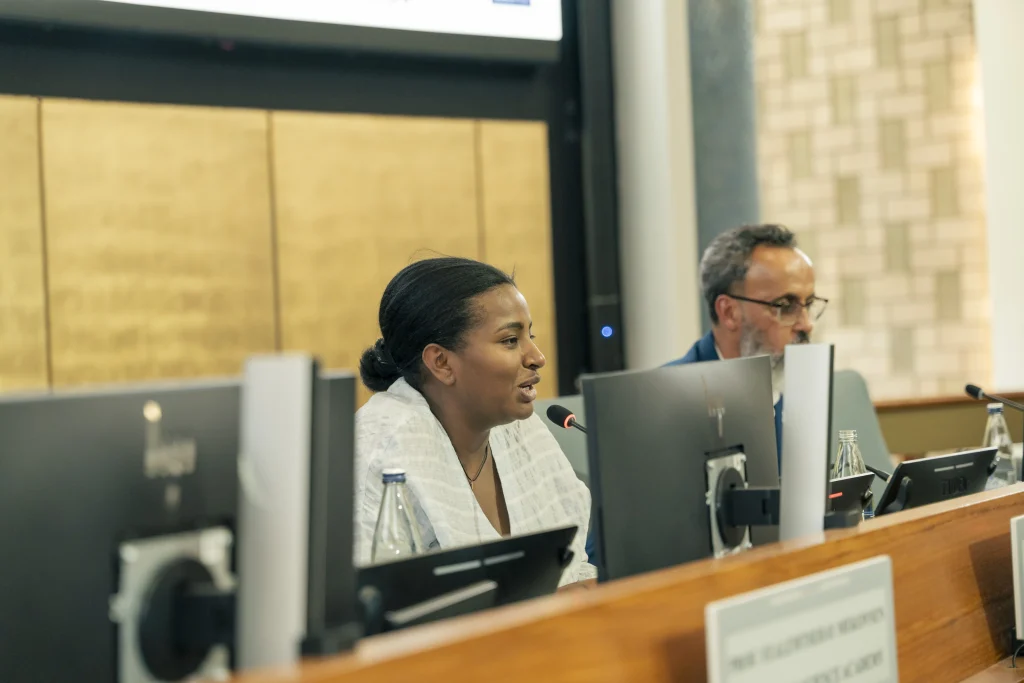
Dr. Bethlehem, the dialogue’s moderator, opened the space with clarity. She introduced the three featured speakers: Prof. Yalemtsehay Mekonnen, Principal Vice President of the Ethiopian Academy of Sciences; Prof. Abebaw Yirga Adamu, Director of Quality Assurance at Addis Ababa University; and Prof. Panos Hatziandreas, Co-founder of Lebawi International Academy.
Before diving into the discussion, Dr. Bethlehem invited the audience to reflect on the deeper purpose of education—not just as a structure or institution, but as a living, evolving process that empowers individuals with the mindset, tools, and moral compass to navigate life. She posed the anchoring question: Are we truly harnessing the transformative power of education, or are we running on empty?
Prof. Yalemtsehay opened by reflecting on her personal and professional journey, highlighting the ongoing underrepresentation of women in education despite decades of reform. She acknowledged promising efforts like the Gender Learning Reform but emphasized that real change demands grassroots ownership, effective implementation, and honest evaluation. She called for data-driven decisions over sentiment or political rhetoric, stressing that reform must be systemic, inclusive, and sustained—centered on resilience, historical context, and long-term investment in gender-sensitive curricula and teacher development.
Dr. Bethlehem then turned to Prof. Abebaw for a policy and systems perspective. He traced the history of Ethiopia’s education reforms—from the imperial era to the present—highlighting how each regime introduced changes that were often fragmented, politically driven, and externally influenced. Despite appearing participatory, many reforms were top-down. He cited the stakeholder consultation on university program lengths, where consensus to maintain the current length was ignored—an example of the illusion of inclusion.
He also addressed the critical teacher shortage. Ethiopia needs 40,000 teachers, yet only a few students are currently training. Low pay, lack of support, and poor morale are driving educators away. He painted a stark picture: universities clinging to outdated programs just to stay open, while 4.2 million students remain out of school due to conflict and instability. “Without restoring dignity to the teaching profession,” he said, “no reform will stick.”
Prof. Panos then shared the story of Lebawi International Academy, born from seven years of research into Ethiopia’s educational history. Lebawi was founded on a radical idea: Ethiopia doesn’t need to adopt foreign models—it needs to rediscover and build upon its own cultural and historical foundations. He argued for an education system that is globally informed but locally rooted—one that cultivates critical thinkers, ethical leaders, and socially conscious citizens. “A third grader leading a football team is already a leader,” he said, “but the system doesn’t recognize that.” Leadership, he believes, should be nurtured early—not introduced abstractly in adulthood.
When Dr. Bethlehem asked about solutions, all three panelists agreed that naming the problem is just the beginning. Prof. Yalemtsehay called for ongoing accountability and community ownership. Reform cannot rest solely with the Ministry of Education—parents, teachers, students, and the public must be involved. She emphasized investment in teacher development, support systems for girls, and acknowledged the private sector’s role, commending AWiB for creating the platform for dialogue.
Prof. Abebaw emphasized student-centered reform, calling for depoliticized curriculum design and inclusive decision-making shaped by those closest to the classroom. Teachers must be empowered not just as implementers, but as agents of change. He advocated for integrating critical thinking as a method of learning, not just a standalone subject.
Prof. Panos added that waiting for top-down reform is a losing strategy. Families, civil society, and the private sector hold tremendous potential to shape a better path forward. “Education isn’t just the government’s job,” he said. “It should be a partnership with the government—it’s everyone’s responsibility.”
During the Q&A, the audience raised pointed concerns: Why isn’t education treated as a national priority? How do we balance mother-tongue instruction with national cohesion? Why is there resistance to change from scholars amid politicization? While all agreed education is a government priority, the real issue, they said, lies in implementation.
Prof. Yalemtsehay affirmed the value of teaching in languages children understand, which improves comprehension and confidence. The challenge, she said, is execution, not principle—language should support learning, not become politicized.
Prof. Abebaw pointed to deep political interference and institutional resistance. Many scholars, he noted, are reluctant to engage due to fear of retribution or professional consequences. He called for a Crisis Emergency Education Reform—an urgent, focused effort to address the systemic challenges that have plagued the education system for too long.
Prof. Panos closed by reminding the audience that transformation won’t come from institutions alone—it will come when people reclaim education as a shared mission. Ministries may set the stage, but real change is carried forward by communities.
As the dialogue came to a close, the message was unmistakable: Ethiopia’s education system is at a crossroads. Despite decades of reform, it remains fragmented, politicized, and disconnected from both cultural roots and global standards. Women and girls continue to face barriers. Teachers are demoralized. Students are left behind. What’s needed now is a unified, student-centered, depoliticized approach—one that invests in teachers, values local wisdom, and treats education as a national pillar. The private sector and civil society have a critical role to play.
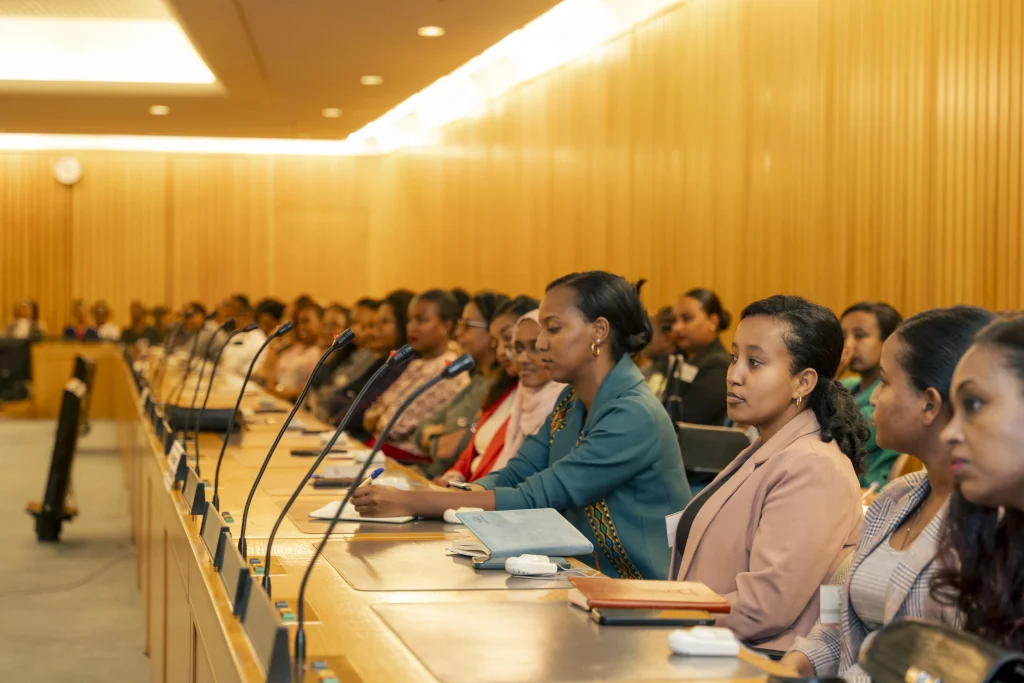
Parallel Session I – Reskilling & Upskilling in the Digital Era
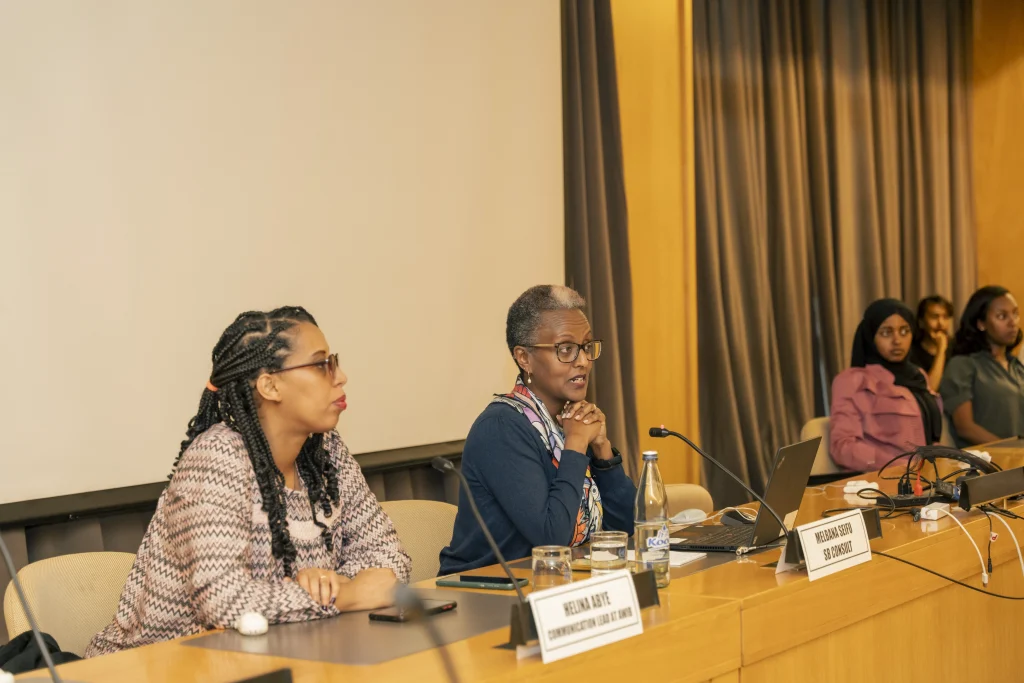
The parallel session on Reskilling and Upskilling in the Digital Era in Conference Room 3 kicked off with a packed room of AWiB members and guests, eager to explore this timely and relevant topic. The session was moderated by Helina Abye, AWiB’s Communication Lead, who warmly welcomed attendees and introduced the speaker, Melbana Seifu, Managing Director of SB Consult, with over 25 years’ experience in architectural and engineering consulting, project management, and organizational leadership.
Melbana began by posing a question about the distinction between digitization and digitalization. She clarified that digitization refers to converting documents or audio into digital formats, while digitalization involves transforming processes and operations using digital tools and technologies. She emphasized that digitization is now essential across all sectors.
Participants shared how digitalization is shaping their industries. One noted how mobile banking has transformed the financial sector. Another highlighted the use of procurement software in pharmacies. A third explained how the agricultural sector benefits from faster information flow along the value chain.
Melbana stressed the importance of foundational skills before diving into upskilling and reskilling. She noted that digital literacy remains underdeveloped in Ethiopia, which presents serious challenges. A participant pointed out how hospitals transitioning to paperless systems face bottlenecks because employees struggle with basic digital tasks, which in healthcare can have dire consequences.
Another concern was the dependency on international digital platforms, which are often expensive or hard to update, making it difficult for Ethiopian businesses to keep up with global trends.
Shifting to the session’s core topic, Melbana asked how participants understood the difference between upskilling and reskilling. Many were unclear. She explained that upskilling involves improving current skills, while reskilling means learning entirely new ones—often for different roles. She emphasized that reskilling doesn’t discard past knowledge but builds upon it.
Participants shared real-world examples, citing workshops, certifications, and adapting to new technologies. Melbana then guided the discussion toward the strategic aspects of upskilling and reskilling—why, when, and how. The consensus: these are urgent needs, especially given the pace of global change. Without continual development, individuals risk losing relevance in an increasingly fast-paced world.
She urged participants to evaluate their current skills within the context of their industries and determine whether upskilling or reskilling was needed. At the corporate level, she stressed workforce development must be a long-term strategy. Organizations that invest in employees benefit from adaptable teams and better retention. “Digitalization is not a trend—it’s a permanent shift,” she said. “Upskilling and reskilling are not optional; they are essential.”
During the Q&A, participants raised concerns about whether the education system prepares individuals for continuous skill development and how Melbana’s experiences shaped her approach. She shared a powerful story of resilience, recounting how she had to reskill at age 29 after her father’s passing—shifting from civil to architectural engineering leadership. Simultaneously, she adapted to industry-wide tech changes that reshaped project design and implementation.
She highlighted the importance of sharing knowledge and recognized that women face unique challenges in upskilling—balancing education, home responsibilities, and limited professional development time. Melbana urged companies to support women in staying competitive.
She added that networking is critical in opening paths for women to grow, lead, and learn. In the final discussion round, participants raised concerns about keeping pace with digital change, especially as parents, and about employee resistance to new technologies due to fear of being replaced. Others mentioned government policies that encourage reskilling to meet digital demands.
Attendees expressed excitement about the session and the broader conference. One male participant appreciated the platform’s commitment to empowering women during a time of rapid change. Another emphasized the need for collaboration between individuals and organizations to navigate the evolving digital landscape.
Concluding the session, Melbana emphasized communicating change supportively to help employees embrace it. She encouraged identifying change agents—individuals who can inspire others to take ownership of their learning and feel empowered by understanding its purpose. By working together and sharing knowledge, we can enhance competitiveness and drive progress.
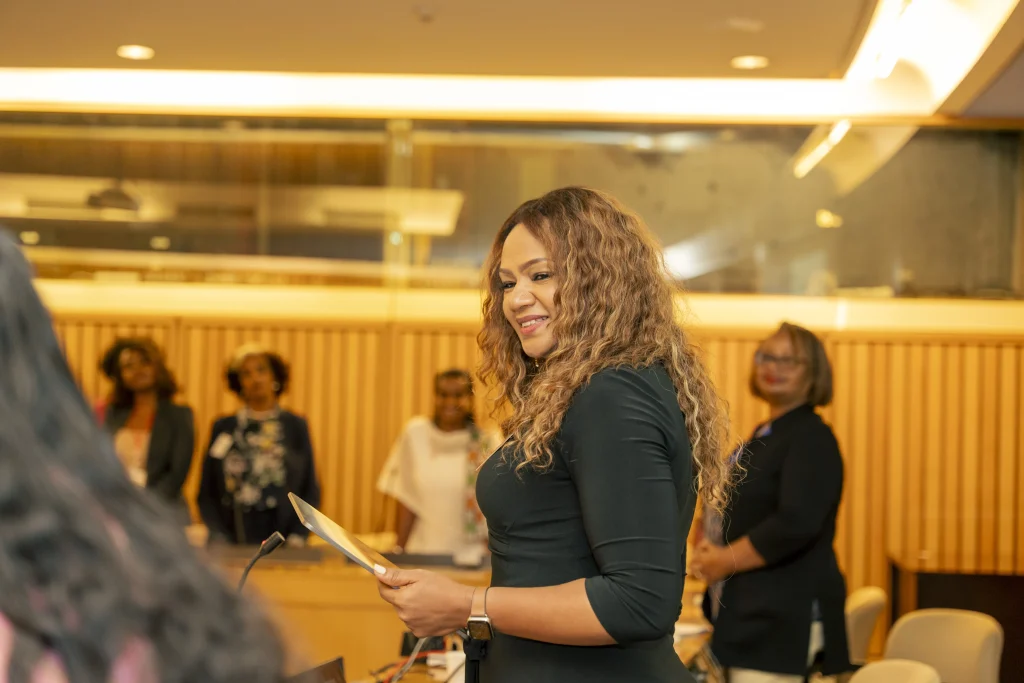
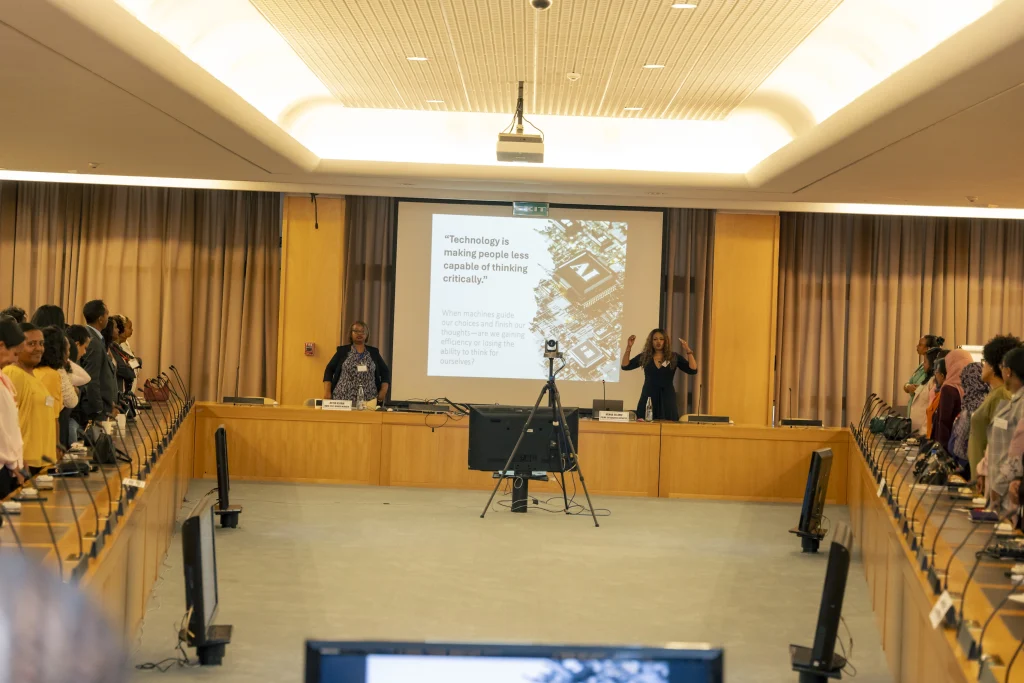
Parallel Session II – Critical Thinking: An Antidote to Misinformation
Critical Thinking, one of the three parallel sessions held at Conference Room 6, was delivered by Menna Selamu, Co-Founder of Prime Integrated Services and Flipper Academy. The session was moderated by Aster Asfaw, AWiB 2025 Board Member and Managing Director of YEP Ethiopia.
Aster began by discussing how the Ethiopian education system is built on memorization. Most Ethiopians aren’t raised to ask why and are encouraged to accept what is said, resulting in unempowered citizens lacking the courage to think critically. In today’s world, where information is abundant, critical thinking is crucial to filter out harmful and misleading content. Without the ability to examine information, challenge assumptions, and ask the right questions, our understanding rests on shaky ground.
Although many have heard of critical thinking, Menna emphasized why discussing it is essential—to confront the problems it faces, to reflect on its importance, and to understand the issues that surround it. Today, most of our information comes from social media, news channels, and the infamous “አሉ” (word of mouth).
Menna explained how we are bombarded by information at unprecedented volume and speed. She challenged the audience to pause and think about who is behind a story—the source—and to put a face to “አሉ.” Word of mouth has been powerful for centuries but is also dangerous for spreading misinformation.
To illustrate, Menna showed footage of Bill Gates in a real interview and a Deepfake version. Though no one was surprised by Deepfake technology’s advances, the accuracy—created in about 72 hours—was unnerving. She stressed that pausing to analyze information is vital, as misinformation can influence perception, behavior, and emotion, leading to bias and conflict.
Menna identified three pillars of critical thinking:
- Analysis – Breaking down information
- Logical Reasoning – Connecting dots to reach conclusions
- Objectivity – Stepping back from bias and thinking clearly
To encourage application, participants engaged in reflective reasoning exercises, debating statements like:
- “Fast decisions are better than perfect ones”
- “A good leader should never change their mind in public”
- “Challenging your boss is a sign of a healthy workplace”
The exercise highlighted the importance of context. Fast decisions may be needed in urgent cases; leaders must balance humility with credibility; and challenging a boss reflects trust but depends on organizational culture. This showed that critical thinking is not binary—it requires nuance and multiple perspectives.
Menna discussed misinformation’s effects, distinguishing between misinformation (unintentional) and disinformation (deliberate). She showed a Deepfake of President Zelenskyy falsely ordering surrender—intended to demoralize Ukrainians. The impact of misinformation differs by context and audience, underscoring the need for media literacy.
Fact-checking initiatives like Zami Reports, Africa Check, AFP Fact Check, and the African Fact-Checking Alliance (AFCA) were introduced as essential tools.
Menna emphasized cultivating critical thinking habits through education. Students should analyze data, challenge assumptions, evaluate sources, and ask thoughtful questions—creating independent thinkers.
Practical tools to strengthen critical thinking included:
- CRAAP Test: Assesses Currency, Relevance, Authority, Accuracy, and Purpose
- Red Team vs. Blue Team: One challenges assumptions, the other defends and improves
- Five Whys: Asking “why” five times to uncover root causes
- SIFT Framework: Stop, Investigate, Find better coverage, Trace claims
These tools help build a culture of critical thinking, enabling better decisions and resilience against misinformation.
The session acknowledged that lack of critical thinking limits students’ ability to question, apply knowledge, and be creative. Promoting it requires reform, teacher development, and a culture of inquiry-based learning.
A lively debate arose on AI’s impact. Some feared it may reduce deep reflection; others saw it as a helpful tool. The consensus: AI can support but not replace critical thinking. Engagement, questioning, and context are key.
Another key discussion was about how much to verify before sharing information. Some feared paralysis by analysis. Participants agreed full fact-checking isn’t always possible, but healthy skepticism, checking credibility, and pausing before reposting are simple, effective habits.
The takeaway: critical thinking isn’t about having all the answers—it’s about asking the right questions.


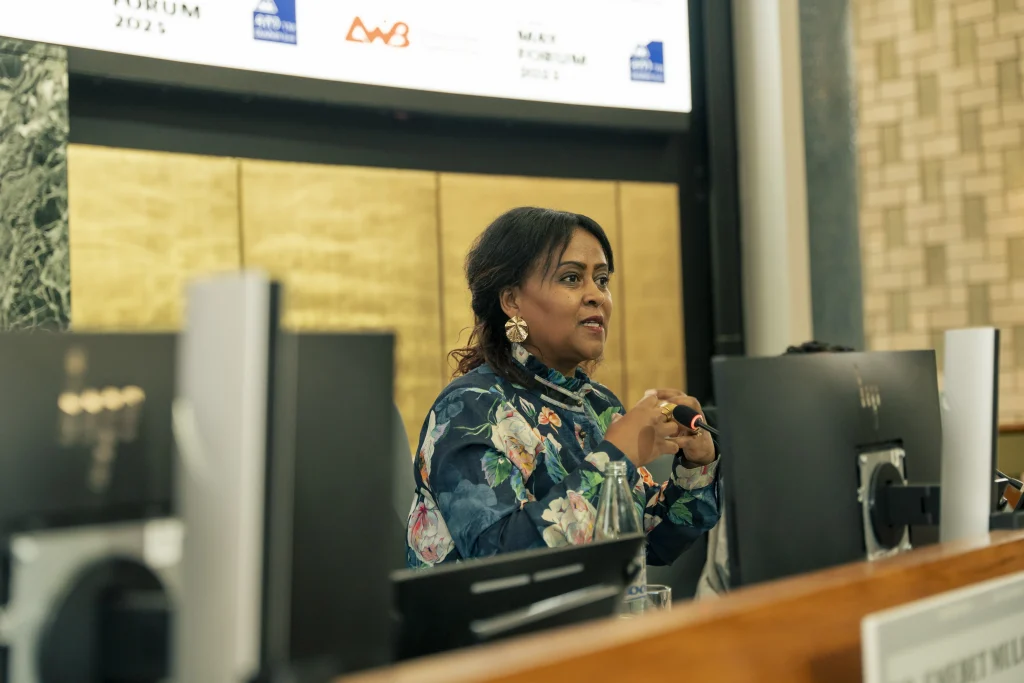
Women in Lead: The Invisible Hurdle & Its Impact
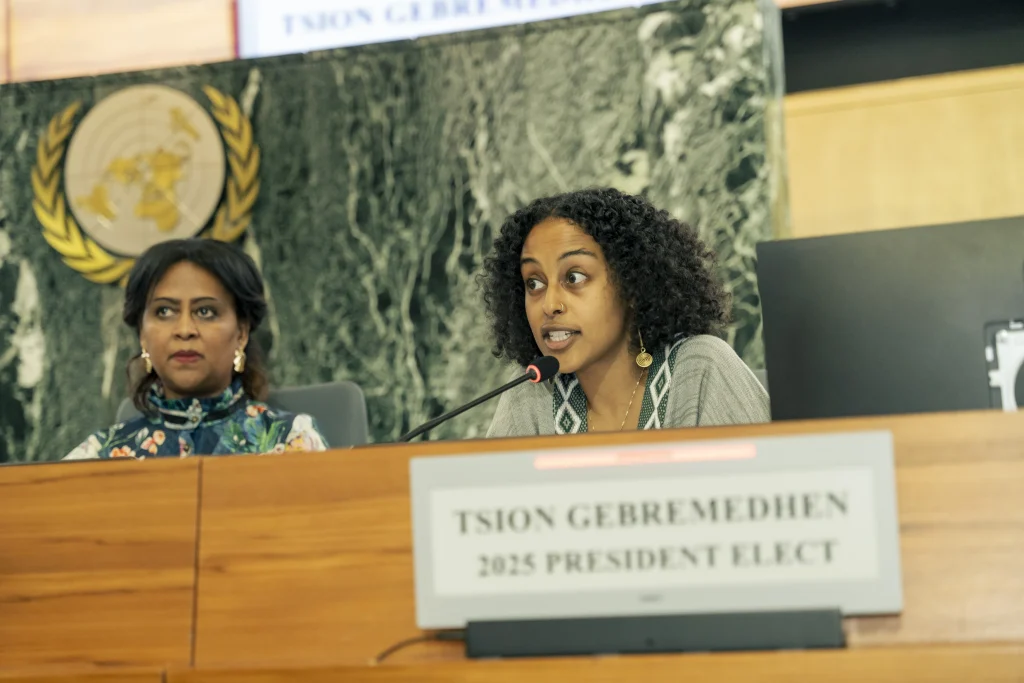
Tsion Gebremedhen, AWiB’s 2025 President Elect, opened the panel by reminding the audience of the thought-provoking theme, “Education: The Great Equalizer or Divider?” She emphasized that learning extends beyond classrooms, shaped by our surroundings and daily interactions. Framing the session as “Women in Lead: The Invisible Hurdle & Its Impacts,” she posed powerful questions: What unseen barriers hold women back from reaching their full potential, and what legacy will this generation leave? With that, she introduced the three speakers and opened the floor.
Dr. Seble Hailu, psychologist, thought leader, and media personality, began with a powerful quote: “Let’s hear it for the bossy ones, for those loud, proud women who stand up and speak out. For their confidence and imperfection, their strength and vulnerability. Let’s hear it for us.” She reflected on the phrase, asking, “Am I bossy, loud, and proud?” What resonated most was being confident yet imperfect, strong yet vulnerable—a truth many silently echoed.
Dr. Seble recounted earning her Ph.D. alongside her three sisters, celebrating with thanks to God, family, and siblings but overlooking her own strength and perseverance. This moment revealed a deeper truth: even experts carry unconscious biases that affect relationships and well-being. She shared research findings with an economist linking women’s psychological trauma to their economic well-being, revealing that unresolved trauma hinders financial success and resource use. Trauma’s invisibility leads to underfunding. She highlighted contributing factors such as childhood experiences, culture, religion, and entrenched gender biases that cast men as leaders and women as nurturers.
Dr. Emebet Mulugeta, Academic VP of AAU and founder of NiaCCFD, shared how her leadership is shaped by her roles as sister, daughter, wife, mother, volunteer, and professional. She stated, “Education is a prerequisite for leadership,” citing a 2021 study: only 31% of university students are women, 11% of Ph.D. lecturers are female, and women hold just 13.4% of board leadership roles, with only two female university presidents. These gaps mean women’s voices are missing in key decisions, depriving them of role models and mentors. “Even with my experience, I’m still searching for a mentor,” she admitted. Dr. Emebet concluded that stereotypes and expectations—both external and internal—are invisible hurdles women face.
Dr. Emebet shared more findings from a study conducted at Hawassa University: male students believe their female counterparts lack perseverance and strength, viewing them as more focused on marriage than education. Female students, shaped by cultural norms, struggle with low self-esteem and exclusion from academic discussions. She emphasized how harassment is normalized, seen as “positive” when women focus solely on studies, and labeled “horror” by men and “negative” when they prioritize appearance. Misconceptions about how women communicate their consent further fuels this behavior, revealing deep-rooted issues.
Dr. Emebet emphasized resilience as key to overcoming invisible hurdles, urging celebration of those who rise despite challenges. She shared how she was elected Academic VP of AAU by simply stating the role as service and responsibility, not personal achievement. She urged women to “BE YOURSELF,” authentic, humble, honest, and persistent, and stressed the importance of cultivating social networks.
Hiwot Alemayehu, Leadership Program Developer, began by celebrating 20 years of marriage and 21 years of professional life. She framed her journey through three concentric circles: Growth, Experimentation & Invention, and Resilience. Raising children while pursuing two degrees, she initially saw these roles as conflicting but shifted to viewing them as interconnected. Quality time with children strengthened their bond, complementing her professional focus.
At 31, Hiwot studied at NYU, despite the hardship of separation from her children. She stated, “It gave me courageous stories to tell them as they grow up.” Using the metaphor of headwind and tailwind, she described public service leadership as facing resistance and delays (headwind), while international organizations propelled her forward (tailwind) but demanded skill upgrades. She recalled a public sector reform where she was labeled either “Mother” or “Evil,” labels not given to male counterparts. Her response was, “I’m a professional woman, here to do the work, not to play roles.” She disengaged, realizing resistance was toward change.
Hiwot’s experimentation included founding social enterprises, CSOs, and family businesses. Not all efforts were recognized; after contributing significantly to a company, she was excluded from its celebration. “We forgot you,” they said. Her takeaway: “If you want to do great things, don’t do it for credit.” She responded calmly, preserving relationships and worked with the company for ten more years, gaining recommendations.
She closed with a call for self and social awareness, positive self-talk, and supportive attitudes. Through her journey, she learned tone of voice impacts communication and influence. Resilience and emotional intelligence anchor true leadership.
Tsion opened the floor for Q&A. The first question addressed self-image and stereotypes in corporate settings. Hiwot distinguished between harmless comments and those affecting careers, advising strategic, emotionally intelligent responses, especially in politicized spaces.
Dr. Seble expanded on self-image, noting many women internalize poor self-image from unconscious biases, becoming their own barriers. She stressed differentiating self-image from others’ perceptions to avoid fitting into limiting systemic formulas. Open dialogue and reflection help reveal self-imposed and systemic limitations.
A newcomer asked about feminism, noting negative comments about attending a feminist event. Dr. Seble explained that in Ethiopia, feminism is often misunderstood or derogatory but emphasized focusing on action against unequal treatment rather than the label.
Dr. Emebet discussed why women may not support each other, citing unconscious biases like “Queen Bee Syndrome,” where women in power undermine others to protect status. Women leaders face resistance and extra pressure, complicating efforts to uplift peers. She shared a personal story contrasting male and female leadership burdens.
The discussion turned to accountability and action. Dr. Seble emphasized awareness must lead to behavioral change and collective healing, drawing from her PhD on social change that personal transformation is necessary to impact society. Dr. Emebet pointed to internalized patriarchy, recalling a student’s abuse report dismissed because she wasn’t married. Hiwot added that even tech shows bias, with AI assistants reinforcing subservient female roles. The discussion closed acknowledging invisible barriers persist, but awareness, resilience, and action can break them down step by step.
Tsion closed the forum sharing her experience growing up in Canada and returning to Ethiopia, finding opportunities aligned with her values. AWiB offers a space for open, sometimes uncomfortable dialogue. As President-Elect for 2025 and President in 2026, she looks forward to bringing more meaningful conversations to the table. With that, she officially concluded AWiB’s May Forum 2025.
Share to your circles!