Deliver Us From Evil: The Faceless Rapist Recap
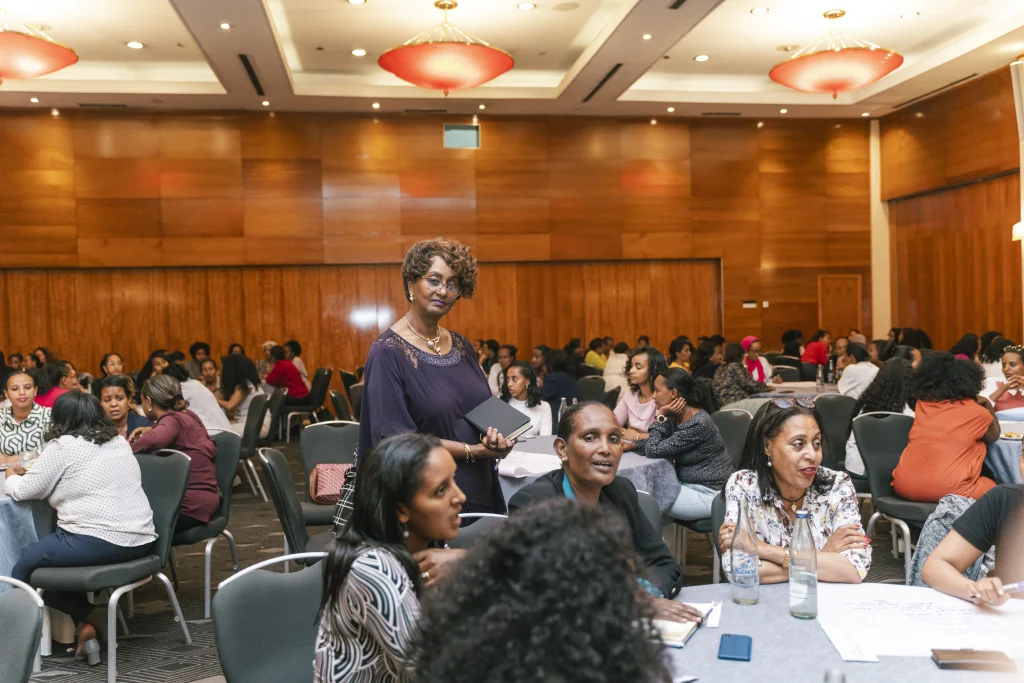
On March 6, in honor of Women’s Month, AWiB hosted a thought-provoking World Café-style dialogue titled “Deliver Us from Evil: The Faceless Rapist” The event provided an open platform for participants to discuss a critical and often unspoken issue—sexual violence and its pervasive impact on society.
The evening began with a vibrant networking session at 5:30 PM, where attendees formed new connections and engaged in meaningful discussions. The discussion kicked off at 6:45 PM with AWiB President-Elect Tsion Gebremedhen acknowledging the night’s sponsors, Enat Bank and Wudassie Diagnostic Center. Enat Bank also provided gifts to attendees in celebration of International Women’s Day.
As part of AWiB’s membership perks, four members introduced their businesses: Saron Tadesse (Maki Raisins), Bethlehem Addisu (Betinatey), Yodit Gidey (GG Enterprises), and Hamrawit Gizaw (Afrobeat Fitness).
The discussion was structured in groups of seven, each with a dedicated host to guide the conversation, document insights, and amplify voices. Attendees rotated between groups after each question, engaging with new perspectives and deepening their understanding of the topic.
Tsion introduced Dr. Seble Hailu, a psychologist and expert in gender-based violence and trauma healing, as the evening’s facilitator. With experience in government, NGOs, and global organizations, Dr. Seble is a leading advocate for mental health and survivor support. A former AWiB President and dedicated mentor, she has worked tirelessly to create spaces for women to reclaim their power and heal from violence. Tsion then gave the floor to her to lead the discussion.
Dr. Seble began by thanking AWiB for having the boldness to bring this important issue to the table. She set the stage by challenging the notion of “The Faceless Rapist” and posed critical questions: Who are the perpetrators? Do we see their faces? Are they hidden in our homes, workplaces, schools, or even among those we trust? Her reflections on transitional justice, victim-blaming, and the complexity of rape culture provided a powerful foundation for the evening’s discourse. Following her introduction, three key questions guided the dialogue, sparking thought-provoking conversations:
- What harmful attitudes and behaviors toward rape and sexual violence do you often see in your environment? What does a rapist look like?
The following ideas were raised at the tables:
- Victim blaming: Shifting responsibility onto the survivor, questioning their actions or attire instead of focusing on the perpetrator’s behavior.
- Minimizing the impact/severity: Downplaying the seriousness of sexual violence, suggesting it was a minor issue.
- Burying what happened: Ignoring or covering up incidents instead of confronting them.
- Intimidation/catcalling: Engaging in unwanted, inappropriate behaviors that create discomfort, often dismissed as harmless.
- Poor laws: Inadequate legal protections and enforcement, especially regarding workplace harassment.
- Not teaching about this taboo: Failing to educate children or communities about boundaries and consent, reinforcing harmful silence around the issue.
- Unnecessary/unsafe proximity: Creating or tolerating situations where individuals are placed in uncomfortable or dangerous environments, often leading to harassment or assault.
After reflecting on the responses from participants to the first question, Dr. Seble referred to the campaign by the Setaweet Movement titled “ምን ለብሳ ነበር? (What was she wearing?)” . The exhibition had showcased what girls and women of all ages were wearing at the time they were victims of sexual abuse. A diaper was part of the showcase proving against the common misconception that rape is about what a woman wears, even as infants in diapers were victims of sexual abuse. In addition, she stressed that perpetrators cannot be easily identified by preconceived notions, as they can come from any background, and sexual violence can happen anywhere, at any time.
- How do you and those around you respond when people joke about or downplay sexual violence, stay silent out of fear or doubt, or show indifference?
The responses included:
- In corporate environments, some individuals may pursue legal action.
- Many prefer to stay silent due to fear, exhaustion, or uncertainty.
- Disappointment can lead to giving up, feeling efforts won’t lead to change.
- Fear often keeps people quiet, fearing judgment, backlash, or retaliation.
- Some may leave the situation, feeling emotionally drained.
- Others confront the speaker or perpetrator directly.
- Many assimilate the discomfort, fearing they may be silenced.
- Fear leads individuals to avoid addressing the issue to prevent retaliation.
- It’s crucial to report incidents rather than hide them.
- Collective action is stronger, as support from others can strengthen the response (“It is also our concern” – “ያገባናል”).
Dr. Seble summarized the points raised and moved on to the third question after the participants had switched tables.
- What actions can we take individually and collectively to address the problem?
Key responses included:
- Have systems in place to hold perpetrators accountable, ensuring they face consequences.
- Create awareness at home and in the workplace, educating about respect, boundaries, and consent.
- Teach what behaviors are inappropriate, ensuring people understand harassment, abuse, and assault.
- Push for policy reform and advocacy, supporting changes that better protect victims and hold perpetrators accountable.
- Support organizations like AWiB working on women’s issues.
- Adopt a survivor-centered approach, ensuring survivors are supported, believed, and given resources to heal and seek justice.
- Speak up, using personal influence and voice to challenge inappropriate behavior.
- Believe survivors, providing validation and support instead of questioning their experiences.
To conclude, Dr. Seble underlined the importance of problem identification as the first step towards finding a solution. She urged participants to rethink preconceived notions and recognize that both men and women can be perpetrators of sexual violence. She also highlighted the increased vulnerability of individuals with disabilities and emphasized the need for open communication within families to help children recognize and report inappropriate behavior.
The key takeaways from her conclusion included the need for awareness creation, as true understanding of sexual violence requires deeper conversations. She called for an end to victim-blaming, urging that shame be placed on the perpetrator, not the survivor. Dr. Seble also emphasized the importance of prevention through policy reforms regarding workplace harassment.
The lack of support for victims of sexual abuse was also highlighted, with a call for expanding shelters and safe spaces, especially in conflict zones. Finally, she advocated for a holistic approach, requiring collaboration at family, community, cultural, religious, and organizational levels.
A participant raised the question, “Why do people rape? And rape sometimes comes from sexual disorders, which are a type of mental disorder—what should we do about that?” Dr. Seble explained that some perpetrators may act out of past trauma, while others are driven by sexual disorders or power imbalances. She emphasized that focusing solely on victims will not prevent future crimes. Society must understand and address the root causes of perpetration. Dr. Seble further stressed that collective healing is necessary at a national level, as Ethiopia has endured decades of trauma, and transitional justice mechanisms are vital in breaking cycles of violence. The discussion ended with a heartfelt thank you to Dr. Seble, the participants, and the men who joined the conversation. In true AWiB tradition, Dr. Seble was presented with a token of appreciation for her invaluable contributions to the dialogue.
Share to your circles!