Men Behind Sheroes Recap
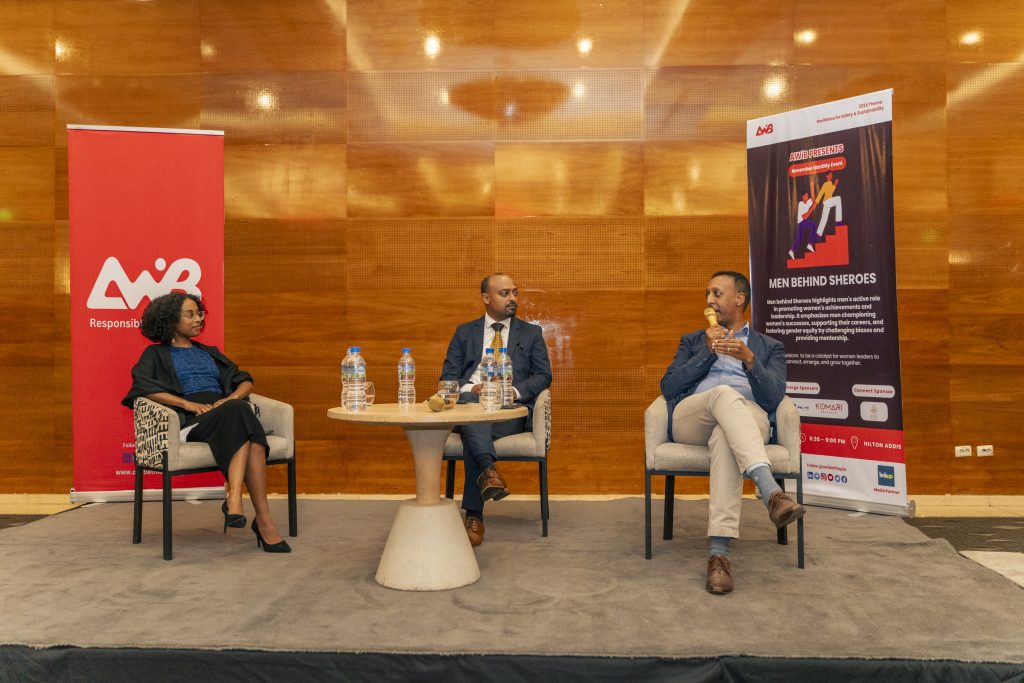
November—a month dedicated to honoring the men who support strong, successful women—the “Men Behind Sheroes” event at the Hilton Hotel was not only a celebration but a powerful reminder of the unsung heroes who champion gender equity every day. As attendees arrived around 5:15 PM, the atmosphere buzzed with anticipation and connection. The networking area was filled with laughter, animated conversations, and friendly exchanges as people from diverse backgrounds came together to share their stories and make new connections. This quickly turned into a warm and vibrant setting, an ideal prelude to a thoughtful evening ahead.
As participants made their way from the networking area into the meeting hall, the mood shifted to one of respectful attentiveness. The panel discussion began, with Lidya Yohannes AWiB’s Membership Programs Manager introducing the sponsors and partners of the night. The partners Empower Addis (Helen Mesfin) and Nu Chika Enabuka (Hamere ) gave a brief introduction about their event. Then the event sponsors, namely Kuriftu Hotel and Spa, Amhara Bank, and Komari Beverages, were introduced and given the opportunity to promote their respective products and services. Additionally, two AWiB members, representing Traditional Clothes (Maria Mamo), and Better Life Healthcare (Betemena Negede) were given a platform to showcase their products and introduce their services.
Lidya then introduced and gave the mic to the moderator for the night Tsion Gebremedhen, an AWiB Board Member, and a Public Health Professional at AMREF.
Tsion began the discussion with a warm welcome and introduced the theme “Men Behind Sheroes”. She challenged the traditional saying, “Behind every strong man is a strong woman,” by focusing on the crucial role men play in supporting strong women. She framed the discussion around Ethiopia’s gender norms, where patriarchal expectations often place women in passive roles while men are seen as confident and bold. Tsion highlighted the importance of gender equity, ensuring women have the support they need to compete on equal terms with men, and addressed how feminism in the Ethiopian context should be adapted to local realities. Tsion then introduced the two guests, Nebil Kellow and Dawit Hailu, and set the stage for a conversation about their experiences and perspectives on gender equality and the roles men play in supporting women both personally and professionally.
Dawit began by introducing his wife, Wudiyé as he calls her, and their daughter, Sifanna, before sharing the story of how he and Wudiyé ’s relationship began. He recalled meeting her through a mutual friend, and after a few months of getting to know each other, he asked her to marry him. Dawit shared key leadership lessons he learned throughout their journey together, starting with the importance of self-awareness in knowing what you want in life. He also emphasized intentionality in their partnership, noting how they opened a joint bank account and worked together toward a shared vision.
Dawit described the challenges they faced, including Wudiyé’s father’s concerns about his financial stability before they got married, and the perseverance required to push through those obstacles. They started their first business, a souvenir shop, and learned how to manage roles, with Wudiyé handling the household finances while Dawit focused on growing the business. As their business expanded, they continued to divide responsibilities, eventually leading to multiple successful ventures, including a diagnostic center, coffee shop, and consultancy.
Dawit credited much of their success to the way they worked as a team, with Wudiyé playing a key role in managing the businesses, particularly after she left her job at UNECA to join the family business. He reflected on how uplifting women means creating space for them to express and exercise their potential, which, in turn, benefits both men and women. Dawit concluded by expressing gratitude for Wudiyé’s support and highlighting how their partnership led to the growth of their businesses and the creation of hundreds of jobs, proving that empowering women empowers families and society as a whole.
Nebil began with a humorous moment, sharing how his wife reacted when he told her he was invited to speak at the “Men Behind Sheroes” event. She joked about him talking about feminism to a group of women, and reminded him that he’s faced tougher situations before, which helped him feel more at ease. He then shared a story about his proposal to his wife, which was a dramatic and elaborate affair, but her response was more pragmatic, asking for time to think it over. This experience, he reflected, showed him how his wife had helped him grow and become a better person, manager, and partner.
He discussed the privilege of being a man, emphasizing how easy it is for men to forget their advantages in a world that often behaves differently toward women. Nebil acknowledged that recognizing this privilege and being conscious of it is an ongoing learning process. He spoke about his role in supporting women at work, particularly in his organization, where he consciously surrounds himself with women because they possess the competencies and traits needed for success in the workplace. However, he also recognized the biases that still exist, even within his organization, and emphasized that much more needs to be done to break down institutional barriers for women.
Reflecting on his parenting, Nebil discussed the importance of raising both his sons and daughters without gender biases. He shared how he and his wife consciously avoid setting restrictive boundaries for their children, encouraging them to pursue their passions regardless of traditional gender expectations. He also mentioned his daughter’s success in publishing a book, which was a direct result of not saying “no” to her aspirations.
Nebil concluded by emphasizing the importance of appreciation in supporting women, stating that true appreciation requires self-awareness and the ability to recognize the different worlds men and women live in. He highlighted that both men and women bring unique perspectives to the table, and the key to supporting women is to open our eyes, appreciate their contributions, and challenge societal norms that impose unnecessary limits.
During the Q&A, the audience commended the speakers for their efforts to uplift women and recognized the challenges organizations face in recruiting qualified women. Dawit shared how his understanding of gender issues evolved after learning to view situations through a “gender lens,” which highlighted the importance of advocating for gender equity, especially among men.
Nebil shared their organization’s success in employing 68% of women, with 61% in leadership roles, showcasing the positive impact of women in leadership. They also discussed work-life balance, emphasizing that responsibilities in a partnership should be negotiated based on individual needs, not societal expectations.
A question about the role of small businesses in the economy sparked a discussion on how these enterprises employ a large portion of the population yet receive minimal financial support. The conversation also highlighted the need for men to speak out in male-dominated spaces to challenge harmful stereotypes and promote change.
Nebil also emphasized the difference between control and influence. As parents or leaders, we can’t control others, but we can guide and influence them through understanding and empathy. This approach—whether in parenting or management—focuses on supporting individuals to make their own choices, learn from mistakes, and grow. For women, this means offering flexibility, recognizing challenges like childcare, and valuing their unique needs. The speakers also stressed the importance of teaching social justice from an early age, recognizing that gender inequality is one form of injustice. Men, in particular, must confront their privilege and play an active role in dismantling it. The key takeaway was that influence, empathy, and understanding are essential to creating inclusive, supportive environments both at home and in the workplace.
As the discussion came to an end, Tsion expressed her gratitude to the speakers and the audience for their insightful contributions. She highlighted the key takeaways: the importance of influence over control and the need to distinguish between equality and equity. Tsion encouraged everyone to take these lessons and apply them, not only in their professional lives but also in their personal spaces, challenging stereotypes and supporting one another.
In keeping with AWiB’s tradition, Tsion presented gifts to the speakers as a token of appreciation for their valuable insights. The night closed gifting those men in the audience in celebration of their courageous spirit to challenge the status quo.
Share to your circles!